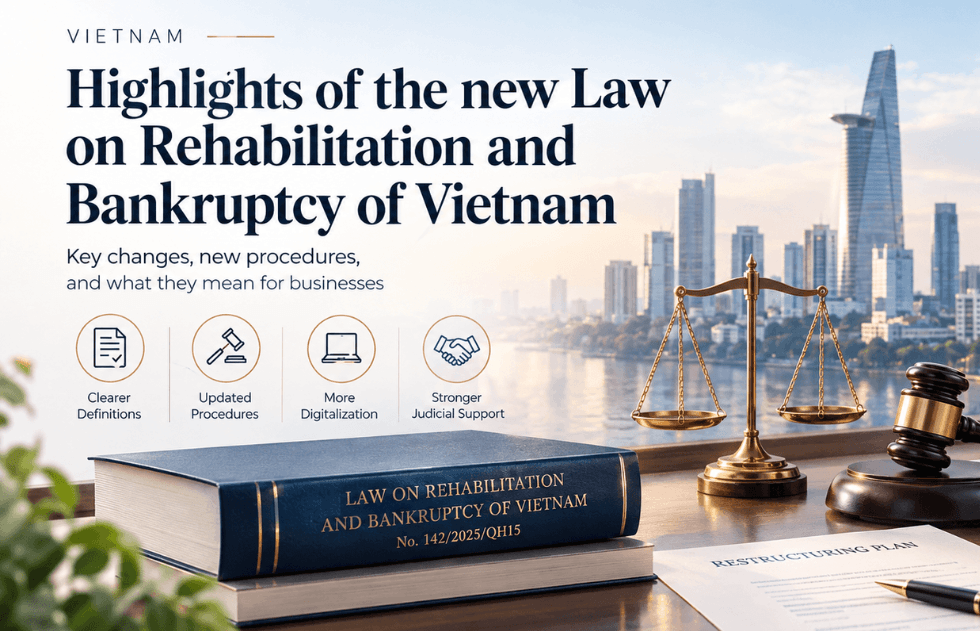
Highlights of the new Law on Rehabilitation and Bankruptcy of Vietnam
On 11 December 2025, the National Assembly of Vietnam passed Law No. 142/2025/QH15 on Rehabilitation and Bankruptcy (hereinafter referred to as “LORB”).
The LORB takes effect from 1 March 2026. It replaces the Law on Bankruptcy in 2014 and its amended Law in 2025 (collectively, “LOB”) from this date, except for the provision on the rights and obligations to file for application of the bankruptcy proceedings applicable to tax management authorities, which will take effect from 1 July 2026.
One significant point of the LORB is its naming, the Law on Bankruptcy and Rehabilitation, which differs from the previous Law, the Law on Bankruptcy, in that it regulates for the Rehabilitation procedure equivalent to the Bankruptcy procedure.
Below is a number of highlights of the LORB:
1. Scope of regulations
The LORB stipulates the principles, procedures, and processes for settling cases of rehabilitation and bankruptcy of enterprises, cooperatives, and cooperative unions (within this article, primarily referring to “enterprises”); and the rights and responsibilities of those involved in these procedures.
2. Some definitions under the LORB
The LORB provides the interprettation of the terms relating to the rehabilitation and bankruptcy procedures, specifically:
• An enterprise at insolvent risk means an enterprise which is unable to pay its debts that are due within 6 months, or debts that are due but not yet exceeded 6 months.
• An insolvent enterprise means an enterprise which fails to perform the obligation to pay its debts within 6 months after such debts become due.
• Rehabilitation means the state of an enterprise which is no longer at the insolvent risk and has received a decision on suspending rehabilitation procedure by a court, or it is not in insolvency and has received a decision on suspending rehabilitation procedure by a court.
• Bankruptcy means the state of insolvency of an enterprise which is declared bankrupt by a court.
• Parties involved in rehabilitation and bankruptcy proceedings include creditors; employees; enterprises; shareholders or groups of shareholders of JSCs; members or groups of members of LLCs; debtors of enterprises; and other individuals with related rights and obligations in the process of resolving rehabilitation and bankruptcy cases (collectively, ‘Involved parties’).
Basically, the terms mentioned above had been retained as interpretted in the LOB. Besides, the LORB has provided some slight amendments, such as amending the deadline to verify an enterprise at insolvent risk is stipulated from 3 months (according to the LOB) to 6 months.
3. General regulations related to the rehabilitation and bankruptcy procedures under the LORB
The LORB specifies the authority, duties, powers, and responsibilities of individuals, authorities, and organizations involved in the rehabilitation/bankruptcy procedures, as well as the duties and powers of those conducting the rehabilitation/bankruptcy procedures, and other individuals, authorities, organizations relating to the rehabilitation or bankruptcy cases.
One new point compared to the LOB is that the LORB stipulates that certain related procedures can be carried out via electronic environment, including:
(i) Issuance, service of process, and notification of court documents.
(ii) Procedure for filing for rehabilitation or bankruptcy.
(iii) Payment of court fees, advance payment of court expenses; payment of rehabilitation/bankruptcy expenses.
(iv) Provision, submission of documents, evidence.
(v) Conduct of hearings to resolve the rehabilitation/bankruptcy case.
(vi) Sale of assets, transfer of enterprises.
Regulations on judicial assistance in the process of resolving insolvency/rehabilitation cases: Previously, judicial assistance was only permitted for cases with foreign elements, based on Vietnam courts’ requests to competent foreign authorities. However, the scope of this judicial delegation has been expanded by the LORB, namely, the judicial delegation can be carried out by other Vietnamese courts (not only by competent foreign authorities) at a request of the court handling the case. For example, the court handling the case may issue a decision on judicial delegation to another Vietnamese court to recover assets, take statements from involved parties, conduct on-site inspections, or appraise assets, etc.
4. Process to carry out the rehabilitation, bankruptcy procedures under the typical manner
4.1. Rehabilitation procedure:
Pursuant to the LORB, the rehabilitation procedure includes the steps: (a) Acceptance of the file for rehabilitation from the enterprise; (b) Preparation of business rehabilitation plan; (c) Establishment of a creditors' meeting (the creditors' meeting is convened by the court); and (d) Implementation of the business rehabilitation plan.
In the course of the rehabilitation procedure, the enterprise can still continue its business operations, but must be under the supervision of the asset management officer/asset management and liquidation firm/the Creditors' Representative Board.
The LORB specifies the individuals/authorities of the enterprise at insolvent risk/insolvent entitled to file an application for business rehabilitation procedures, including: the legal representative, the board of directors/board of members/owner.
The legitimate consequence of the rehabilitation procedure is that the court will decide whether to (i) suspend the rehabilitation procedure; or (ii) approve the rehabilitation procedure. In case of (i), the matter will be forwarded to the next stage of the process, which is the execution of the bankruptcy procedure; and in case of (ii), the enterprise is no longer in the state of insolvent risk or insolvency, and has been approved for the rehabilitation of business activities.
4.2. Bankruptcy procedure
The LORB regulates the procedures for conducting the bankruptcy, including: (a) Acceptance of file for bankruptcy applicable to the enterprise at insolvent risk; (b) Initiation of the bankruptcy procedure; (c) Establishment of a creditors' meeting (the creditors' meeting is convened by the court); and (d) Declaration of the enterprise bankrupt.
In general, the bankruptcy procedure remains the same as under the LOB. However, the LORB has also provided some amendments, such as:
Regulations on applicants for the bankruptcy procedures ('Application form'): The LORB has been adjusted regarding those entitled to file an Application form. A part from those entitled to file under the LOB (e.g., creditors, employees, etc.), the LORB has also amended and supplemented regulations concerning other individuals/organizations who may file an application, such as: shareholders, groups of shareholders owning 20% or more of the common shares or a smaller percentage as stipulated in the company's charter of JSCs; members, group of members owning 65% or more of the total charter capital, or a smaller percentage as stipulated in the company's charter of LLCs with two or more members. In addition, the LORB also specifies individuals who are obligated to file an application, such as: the legal representative; the board of directors/board of members/owner of the enterprise.
Furthermore, under the LORB, relevant authorities, such as tax authorities and social insurance authorities, can also file application forms requesting bankruptcy procedure against any enterprises that are late or evade social insurance contributions, despite not responding to notifications from the social insurance authorities for the past three consecutive years.
5. Simplified procedures for rehabilitation and bankruptcy:
A part from the procedures under the typical manners above, the LORB also stipulates that the rehabilitation and bankruptcy should be conducted under simplified procedures if one of the following cases falls into:
1. For the simplified rehabilitation procedure, the enterprise (i) has 20 or fewer unsecured creditors and a total principal debt does not exceed VND 10 billion; or (ii) is a small or micro-enterprise;
2. For the simplified bankruptcy procedure, other than the same cases as those applying for the above simplified rehabilitation, the enterprise may no longer have assets or still has assets though but cannot liquidate/recover them or such remaining assets cannot be enough to pay bankruptcy costs, advance bankruptcy expenses, or full bankruptcy expenses; or it may be a credit institution/ insurance company/ reinsurance company.
It should be noted that the deadline for the simplified procedures will be half the one for the typical procedures.
6. Bankruptcy procedures applicable to credit institutions
The LORB stipulates the process for carrying out the bankruptcy procedure for credit institutions as follows:
Based on the application form for bankruptcy procedure applicable to a credit institution submitted by the applicants entitled/obligated to make the request, the court will accept the application file eclosing the SBV’s letter on terminating special control/not applying solvency rehabilitation measures/terminating the application of solvency rehabilitation measures when the credit institution remains insolvent, and then issue a decision to open bankruptcy procedure within 10 days.
Subsequently, the value of the credit institution's assets will be distributed in the following order of priority:(i) bankruptcy expenses; (ii) outstanding wages, mandatory social insurance contributions, severance pay, and other employee benefits. (iii) deposits remaining after deducting the amount already paid to depositors by the deposit insurance organization; amounts paid by the deposit insurance organization to depositors at bankrupt credit institutions; unpaid deposit insurance premiums; and late payment penalties for deposit insurance premiums. (iv) financial obligations to the State; unsecured debts payable to creditors on the list of creditors; secured debts that remain unpaid as the value of the collateral is insufficient to cover the debt; (v) in case, after completing item (iv), the value of the credit institution's assets still remains, the remaining amount will belong to the owner/contributing members/shareholders of the credit institution; (vi) in case the value of the credit institution's assets is insufficient to pay for items (i) to (iv), those items will be paid in proportion to the amount of debt.
Within 30 days from the date the Asset management officer or the Asset management and liquidation firm completes the list of creditors, debtors, and asset inventory of the credit institution, the court will issue a decision declaring that credit institution bankrupt.
Within 10 days of receiving the decision declaring the credit institution bankrupt, the owner of assets entrusted to the credit institution, entrusted to the credit institution for safekeeping, or managed by the credit institution through an entrustment, safekeeping, or asset management contract must present documents proving ownership and related records and documents to the civil enforcement authority to reclaim their assets.
One notable point in the LORB that the rehabilitation procedures, whether in the typical or simplified manner, do not apply to credit institutions, insurance companies, and reinsurance companies.
-------------------------------------------------------------------------
Disclaimer:
This article is reprinted from MUFG BizBuddy and is reproduced for informational purposes only.