Artificial Intelligence (“AI”) Governance in Singapore: How Businesses can Address Legal Risks and Meet Regulatory Expectations
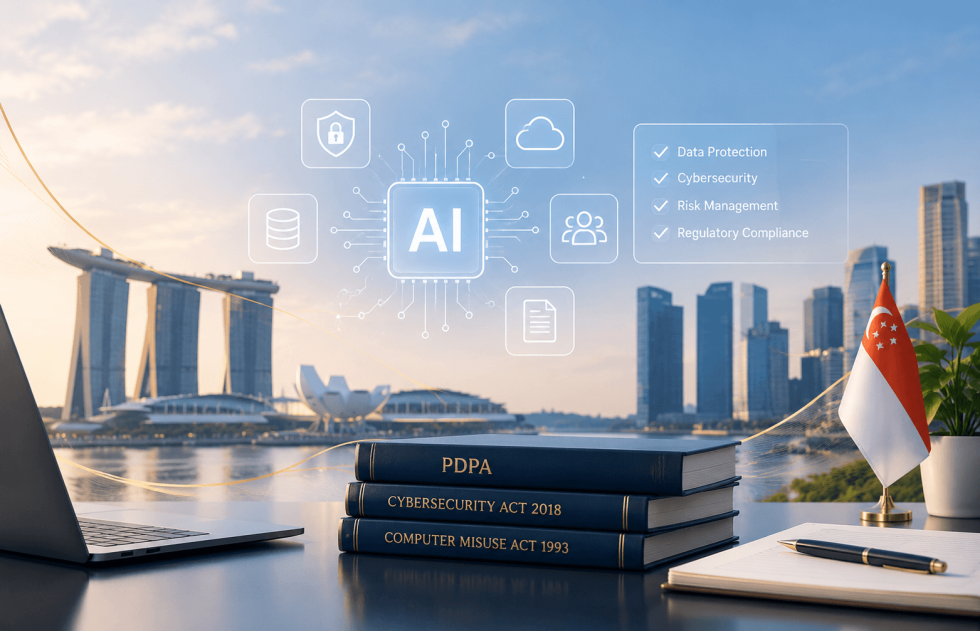
At present, Singapore does not regulate AI through a single “AI Act”. Instead, regulators expect businesses to govern AI by applying existing legal duties – especially concerning personal data protection, cybersecurity, and, for regulated sectors, technology and model risk management – while aligning with national AI governance guidance. For businesses, the practical question is less “Is AI regulated?” and more “How do we design, deploy, and monitor AI so we can show compliance if a sector regulator asks?”
(1) Start with a PDPA-first design: most AI failures are data protection failures
If your AI touches personal data, the Personal Data Protection Act 2012 (the “PDPA”) will be of primary significance. In practice, the Personal Data Protection Commission (the “PDPC”) will look for evidence that you built and ran the AI in a way that satisfies the PDPA’s core obligations – not just a privacy policy.
What to do (and why it matters):
- Be clear on your lawful basis and purpose before training or deploying. Under the PDPA’s Consent Obligation (sections 13–15) and Purpose Limitation (section 18), you should be able to articulate: (1) what personal data you are using; (2) for what purpose; and (3) why a reasonable person would consider that purpose appropriate. For AI, this means documenting the specific use case and resisting “collect now, decide later.”
- Control secondary use and “model reuse.” A common AI governance pitfall is reusing datasets or models for new purposes. Even if the original data collection was compliant, the new use must still fit within PDPA purpose and notification expectations (and often requires fresh consent/notification).
- Build security and access controls around training data and models. The Protection Obligation (section 24) effectively requires reasonable security arrangements. For AI, regulators will expect controls not only for databases, but also for training pipelines, feature stores, model artifacts, prompt logs (for Generative AI tools), and vendor access.
- Prepare for breaches and be ready to notify the PDPC and potentially affected individuals. The 2020 amendments to the PDPA introduced mandatory breach notification under the PDPA (e.g., section 26D). If your AI stack increases the chance of leakage (such as prompt injection, misconfigured storage, and/or vendor exposure), you should treat incident response as part of AI governance – not an IT afterthought.
- Keep only what you need, for only as long as you need. The Retention Limitation Obligation (section 25) matters for model training: retaining raw personal data indefinitely “just in case we retrain” can create unnecessary risk. Businesses should define retention for both datasets and derived data (e.g., embeddings and fine-tuning sets).
Takeaway for businesses: Your best defence in an investigation is a paper trail showing you made deliberate PDPA-aligned choices on key metrics like purpose, data selection, controls, and retention.
(2) Treat AI as a technology risk issue, not just a product feature
Even outside regulated sectors, Singapore’s enforcement posture increasingly expects organisations to show operational control of digital systems. Two laws shape the baseline risk: the Cybersecurity Act 2018 and the Computer Misuse Act 1993.
What to do:
- Secure AI systems against emerging attack vectors. AI introduces new vectors (e.g., prompt injection, data poisoning, model extraction). If you operate systems that are critical to operations – or you are a supplier to such systems – design your controls as if you will need to justify “reasonable security arrangements” (the PDPA, section 24) and adhere to robust cybersecurity hygiene standards.
- Plan escalation and reporting where relevant. If you own or operate Critical Information Infrastructure (“CII”), the Cybersecurity Act 2018 includes incident reporting and compliance direction powers (e.g., sections 14–15). Even if you do not own or operate CII, customers like banks, telecommunications companies, and essential services providers may contractually flow these obligations down to you. Align your incident response and recording/monitoring so you can support their regulatory timelines.
Takeaway for businesses: Regulators and enterprise customers will judge you on whether you engineered controls for foreseeable AI-specific threats, not whether a breach was “unintentional.”
In Singapore, the regulatory landscape makes clear that AI governance cannot be left to luck, but must be handled with discipline – data handled with care, systems secured against the obvious and the novel, and decisions that can be explained without hand-waving. Treat governance as the architecture beneath your models – strong enough to hold everything up, and visible enough to earn trust. When consent is respected, risks are tested, and accountability is clear, AI stops being a leap of faith and becomes something sturdier: a tool that earns trust, survives scrutiny, and scales without losing its integrity.
-------------------------------------------------------------------------
Disclaimer:
This article is reprinted from MUFG BizBuddy and is reproduced for informational purposes only.