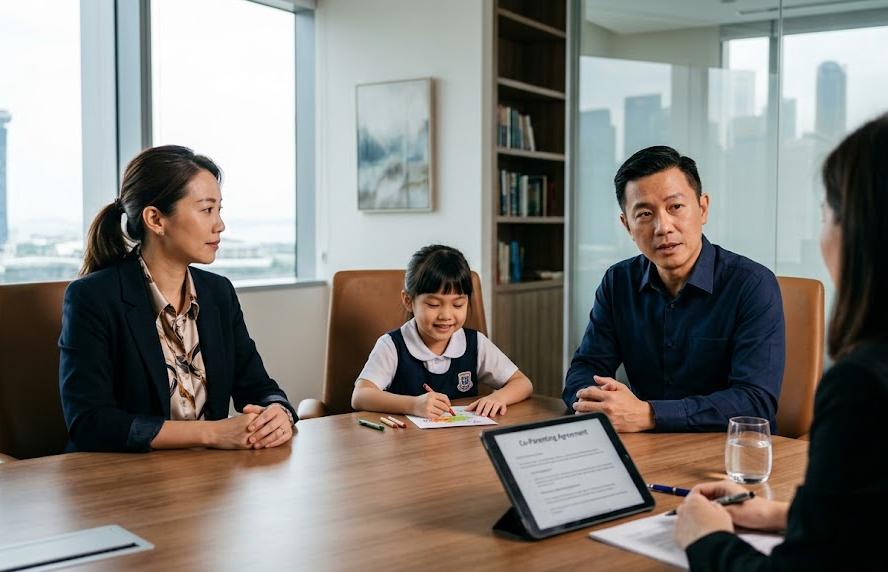
Ending A Marriage, Preserving A Family: The Co-Parenting Programme and Child-Centric Divorces in Singapore
Divorce is often seen as a way forward for individuals who no longer see a future in living under the same roof. However, where a child is involved, the question becomes more complex: what happens to the children of the marriage? Guided by the principles of Therapeutic Justice, Singapore’s family justice system emphasizes healing, problem-solving, and de-escalating conflict. For this reason, the law introduces a statutory step before divorce proceedings involving minor children may commence: the Mandatory Co-Parenting Programme.
THE DIVORCE PROCESS IN SINGAPORE
Generally, the divorce process in Singapore is follows two stages: the dissolution of the marriage and the determination of ancillary matters.
The dissolution of marriage refers to the legal proceedings in which the Court determines whether the marriage has broken down irretrievably. Following the amendments to the Women's Charter that took effect in July 2024, couples can cite Divorce by Mutual Agreement. This allows parties to take joint responsibility for the marital breakdown without the need to assign fault, such as unreasonable behaviour or adultery, thereby reducing acrimony. Parties citing Divorce by Mutual Agreement must provide a joint statement detailing their efforts to reconcile and their considerations for post-divorce financial and child arrangements. If the Court is satisfied that the marriage has irretrievably broken down, an Interim Judgment is granted.
Ancillary Matters form the second stage of the proceedings, where the Court determines issues such as the division of matrimonial assets, child custody, care and control, and maintenance for the spouse and children. Where parties reach an agreement on both the divorce and all ancillary matters beforehand, or where they are able to agree on the divorce but unable to reach an agreement on all ancillary matters, the Originating Application can be filed on the Simplified Track. The Court will review the before granting a consent order followed by the Final Judgment. Otherwise, the case proceeds on the Normal Track, where matters are determined by the Court after the parties file the necessary affidavits and supporting documents.
THE MANDATORY CO-PARENTING PROGRAMME
The Mandatory Co-Parenting Programme (CPP) aims to safeguard the well-being of the child and foster a child-centric approach to divorce. Previously required for contested divorces, the law was updated in July 2024 to mandate that all divorcing couples with children under the age of 21, including those filing amicably on the Simplified Track or under Divorce by Mutual Agreement, must complete the CPP before filing for divorce.
The CPP is a statutory requirement under the Women’s Charter. If either parent fails to complete the programme within the prescribed timeframe prior to filing, they will not be permitted to commence divorce proceedings or file a cross-application.
Administered by the Ministry of Social and Family Development’s Family Assist portal the programme assists parents in making well-informed decisions that prioritize their children’s welfare, addressing practical realities such as housing, schooling, and day-to-day care arrangements. It comprises two components: e-learning and consultations with a counsellor.
FIRST COMPONENT: E-LEARNING
The e-learning component features self-assessment tools that help parents better understand their marital situation, co-parenting dynamics, and their children’s psychological and emotional needs. It takes approximately 1.5 hours to complete and must be done individually by each parent. Parents who face technical difficulties or require assistance may approach a Strengthening Families Programme@Family Service Centre (FAM@FSC) for support. This component prepares parents for the subsequent consultation sessions by offering insights that facilitate meaningful discussions with counsellors.
SECOND COMPONENT: CONSULTATION WITH COUNSELLOR
Within six months of completing the e-learning component, parents must attend a consultation session with a counsellor. This may be done individually, or jointly if both parties agree and have completed the e-learning beforehand. The consultation sessions are designed to support parents in establishing a practical co-parenting plan after divorce.
Each session typically lasts over an hour, and parents may be required to attend between one and three sessions, as determined by the counsellor. This assessment takes into account factors such as the parties’ co-parenting dynamics, their intentions regarding the marriage, and the children’s circumstances. Where necessary, additional sessions may be recommended to address co-parenting challenges, joint decision-making, and conflict de-escalation.
According to reports from the Ministry of Social and Family Development, more than 90% of parents who have completed the CPP report gaining an understanding of how divorce impacts both themselves and their children.
CONCLUSION
While divorce marks the end of a marriage, the law recognises that the responsibilities of parenthood are lifelong. Measures such as the Mandatory Co-Parenting Programme, coupled with the introduction of Divorce by Mutual Agreement, reflect legislative intent to minimise disruption to the child’s life and support parents in navigating this transition with care. By encouraging thoughtful decision-making, cooperation, and a focus on stability, the therapeutic justice process seeks to help families adjust to a new normal. In this environment, children can continue to grow, adapt, and move forward with consistency and security.
-------------------------------------------------------------------------
Disclaimer:
This article is reprinted from MUFG BizBuddy and is reproduced for informational purposes only.