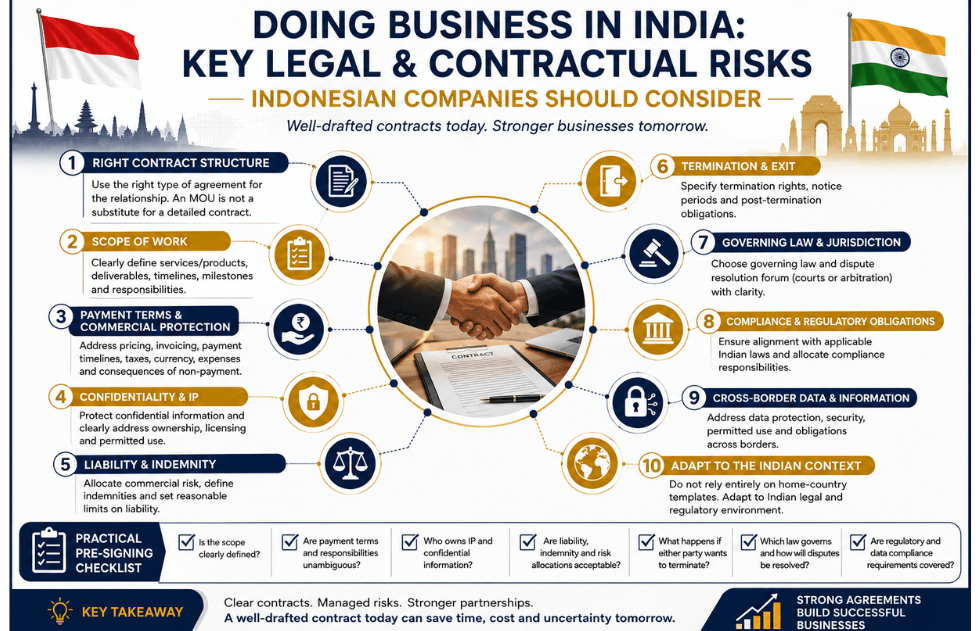
DOING BUSINESS IN INDIA: KEY LEGAL & CONTRACTUAL RISKS INDONESIAN COMPANIES SHOULD CONSIDER
A Practical Guide for Indonesian Businesses Entering the Indian Market
When an Indonesian company enters the Indian market, its first legal consideration is often the structure of its business presence. However, once commercial operations begin, the quality of its contracts and legal documentation can have an equally significant impact on the success of the business.
For Indonesian companies doing business with Indian entities, the key question is not simply “Do we have a contract?” but rather “Does the contract adequately protect our commercial interests in India?”
1. Choose the Right Contract Structure
Different commercial relationships require different forms of documentation.
The contract should clearly establish who is responsible for what, when performance is due and what happens if the arrangement does not proceed as expected.
2. Clearly Define the Scope of Work
One of the most common sources of commercial disputes is uncertainty about what each party is actually required to deliver.
Contracts should clearly define the scope of services or products, specifications, milestones, timelines, deliverables, acceptance criteria and responsibilities of each party.
What is not clearly defined at the beginning can become a dispute later.
3. Payment Terms and Commercial Protection
Payment provisions should be more than a statement of the contract price.
For cross-border transactions, whether applicable foreign-exchange requirements affect the transaction.
Indian foreign-exchange rules regulate various transactions involving residents and non-residents, making appropriate structuring and compliance important for cross-border commercial arrangements.
4. Confidentiality and Intellectual Property
Indonesian companies entering the Indian market may share valuable business information, trade secrets and other intellectual property.
Confidentiality provisions should therefore clearly identify what information is protected.
Clearly address ownership, licensing rights, permitted use and rights upon termination.
This is particularly important where an Indonesian company is providing technology or intellectual property to an Indian customer or partner.
5. Liability and Indemnity
A contract should clearly allocate commercial risk between the parties.
Indemnity provisions may address specific risks such as third-party claims, depending on the nature of the transaction.
Similarly, limitation-of-liability provisions should be carefully considered.
The commercial objective should be to establish a reasonable and clearly understood allocation of risk, rather than relying on standard boilerplate language.
6. Termination and Exit
Every long-term commercial relationship should address how it can come to an end.
It should also establish notice requirements and the consequences of termination.
A good contract should therefore provide not only a roadmap for the relationship but also a clear exit route.
7. Governing Law and Jurisdiction
For an Indonesian company contracting with an Indian entity, the contract should clearly address which law governs the agreement and where disputes will be resolved.
Indian arbitration law recognises international commercial arbitration and provides a framework for enforcement of qualifying foreign arbitral awards in India.
The dispute-resolution clause should therefore be drafted as a meaningful risk-management provision.
8. Compliance and Regulatory Obligations
Commercial contracts should also reflect the regulatory environment applicable to the particular transaction.
A contract cannot remove a statutory obligation merely by allocating responsibility between the parties. However, clear contractual allocation can help establish who must perform what and who bears the contractual consequences of non-compliance.
9. Cross-Border Data and Information
Modern commercial relationships increasingly involve the exchange of personal and business information across jurisdictions.
The parties should consider the applicable data-protection requirements and establish appropriate contractual safeguards.
10. Do Not Rely Entirely on a Home-Country Template
Best Practice - retain the organisation's global commercial standards while adapting the contract to the Indian legal and regulatory environment.
A Practical Pre-Signing Checklist
Before signing a significant agreement with an Indian business partner, an Indonesian company should ask:
- Is the scope of work clearly defined?
- Are payment obligations and commercial responsibilities unambiguous?
- Who owns the intellectual property and confidential information?
- Are liability, indemnity and risk allocation provisions commercially acceptable?
- What happens if either party wants to terminate the relationship?
- Which law governs the contract and how will disputes be resolved?
- Have applicable Indian regulatory and compliance requirements been considered?
The practical approach is therefore simple:
Understand the Indian legal environment.
Protect the commercial relationship.
Document the obligations clearly.
Plan for both performance and exit.
For an Indonesian company doing business in India, investing in appropriate legal and contractual review at the beginning can often be far less costly than resolving an avoidable contractual dispute later.
Authored by Adv. Santoshmurthy Vashista
Founder and Partner
Googe Link: https://maps.app.goo.gl/soTWm6aHQmjPS21D8
📞 +91 96113 44455 | ☎ +91-080-6878 5632
✉️ svlegalconsultant@outlook.com | vashista1975@yahoo.co.in
🌐 www.svlegalconsultant.com