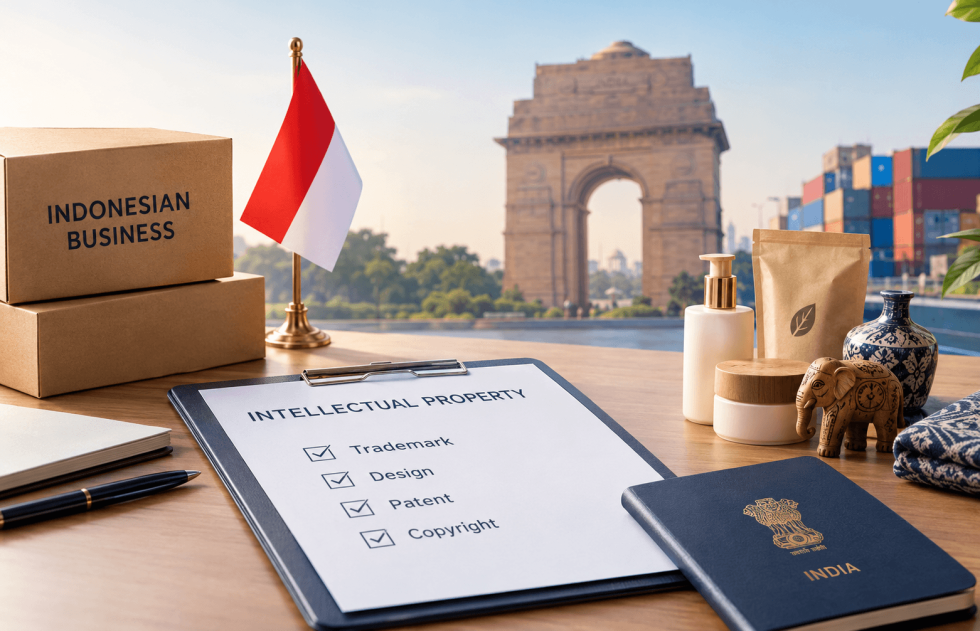
Intellectual Property in India: A Pre-Entry Guide for Indonesian Businesses
India is a large, fast-moving market, and Indonesian companies are looking at it more seriously than ever — food and beverage brands, personal care, textiles, palm oil derivatives, packaging, furniture, and increasingly software and fintech. Most of these companies plan the usual things first: a distributor, a local partner, pricing, customs duties, and GST.
Intellectual property (IP) usually comes later. That is the mistake.
In India, IP problems are cheap to prevent and expensive to fix. A trademark that costs a few hundred dollars to file today can cost tens of thousands of dollars to recover in court three years later — if you recover it at all. This article covers the practical points an Indonesian business should settle before the first shipment, the first franchise agreement, or the first marketing campaign.
1. File your trademark before you enter, not after
This is the single most important point.
For getting registered rights, India works on a first-to-file basis: your rights date back to the application date, and Section 28 of the Trade Marks Act, 1999 gives the registered owner the exclusive right to the mark.
But India is also a common law country, and Section 34 protects an honest prior user against a later registrant. Some Indian practitioners therefore describe India as a first-to-use jurisdiction, where the rights of the first user take precedence over the first filer..
Both statements are partly true, and the practical lesson for an Indonesian company is uncomfortable:
- If you have not filed and have not used your mark in India, you are the weakest party in the room.
- Someone else — often a former distributor, an importer, or a lookalike local brand — can file your name first.
- Fighting them means proving prior use, reputation, and bad faith. That is slow, expensive, and uncertain.
So file early. Even a modest filing before market entry converts a difficult evidence battle into a simple ownership argument.
Two practical notes:
- Timelines are long. An uncontested application currently takes roughly 12 to 18 months to registration. Your rights run from the filing date, but the certificate takes time — plan for it.
- Opposition deadlines are strict. Once a mark is advertised in the Trade Marks Journal, anyone can oppose it within four months, and Indian law gives no extension. This cuts both ways: it is your deadline to stop copycats, and their deadline to attack you. Watch the Journal, or pay someone to watch it for you.
Also check your brand in Indian script and Indian pronunciation. A Bahasa name that sounds fine in Jakarta may already resemble a registered Hindi or regional mark, or may mean something unfortunate in an Indian language. Do a clearance search before you print packaging.
2. Register your product's look and shape — before you launch it
Many Indonesian exporters compete on design: bottle shapes, furniture profiles, textile patterns, packaging.
India protects these under the Designs Act, but with a hard rule: novelty is judged worldwide. A design must not have been published in India or anywhere else before the priority date. Selling the product at home, launching it online, or putting it in a catalogue can destroy novelty. There is only a narrow six-month grace period, mainly tied to disclosure at a government-notified exhibition, and no general grace period.
Meaning: if your product has been on shelves in Indonesia for two years, design registration in India may already be impossible. File in India (or use a Paris Convention priority claim within six months of your first filing) while the design is still new.
The good news: design registration is comparatively fast. The Designs Wing aims to register a properly filed application within about three months of filing.
3. Understand what India will not patent
If your business is technology-based, expect India's patent law to be stricter than you assume.
Section 3(k) of the Patents Act, 1970 excludes mathematical methods, business methods, computer programmes "per se", and algorithms. Software is not banned outright — it can be patented where it meets novelty, inventive step, and industrial application and does not fall foul of the "per se" exclusion — but a pure fintech workflow or e-commerce process will usually struggle.
For pharmaceuticals, agrochemicals, and food processing, Section 3(d) limits patents on new forms of known substances. If your Indian entry depends on a patent that was granted easily elsewhere, get an Indian opinion before you build the business case around exclusivity.
4. Two Indian rules that surprise foreign companies
Foreign filing licence (Section 39). No person resident in India may file a patent application outside India without either first filing in India or obtaining written permission from the Controller. It is residency-based, not citizenship-based. So if you set up an R&D team or engineering centre in India, inventions made by your India-based staff cannot simply be filed in Jakarta or Singapore first. Build this into your R&D and invention-disclosure process from day one.
Working statements and compulsory licensing. Indian patentees and licensees must periodically file Form 27, declaring whether the patented invention is worked commercially in India, under Section 146 and Rule 131. This information is public, and it matters: any interested party may apply for a compulsory licence at any time after three years from grant, including on the ground that the reasonable requirements of the public are not being met. Holding an Indian patent and doing nothing with it is not a neutral position.
5. Get the contracts right, because trade secrets have no special statute
India has no dedicated trade secrets law. Confidential information is protected mainly through contract and general legal principles. For an Indonesian company entering through a distributor, a contract manufacturer, or a joint venture, this means the paperwork does the heavy lifting:
- Ownership clause: the brand, artwork, recipes, moulds, and tooling belong to you, not the local partner.
- No-filing clause: the partner shall not apply to register your marks or designs in India in its own name, and must transfer any such filing to you.
- Confidentiality and non-use obligations that survive termination.
- Exit clause: on termination, the partner stops using the brand, removes signage and online listings, and returns materials.
- Governing law and forum you can actually enforce.
The most common IP dispute involving foreign brands in India is not counterfeiting by strangers. It is the former partner who registered the brand, kept the customer list, and continued selling.
A simple pre-entry checklist
- Clearance search for your brand in India, including phonetic and translated equivalents.
- File trademark applications in the relevant classes — before the first shipment or announcement.
- Check design novelty; file designs in India while they are still unpublished, or use priority.
- Get an Indian patentability view on any technology you are relying on, especially software or pharma.
- Set your Section 39 process if you will have India-based inventors.
- Diarise Trade Marks Journal watch, renewal, and Form 27 deadlines.
- Put IP ownership, no-filing, confidentiality, and exit clauses into every India agreement.
- Appoint an Indian address for service and a local agent so official communications never go unanswered.
Why this matters
India rewards companies that arrive prepared. The system is functioning, the courts take brand rights seriously, and registrations — once held — are genuinely useful commercial assets. But India also runs on documents, dates, and deadlines, and it does not forgive a company that skipped them.
For an Indonesian business, the total cost of doing this properly before entry is small compared with a single marketing campaign. The cost of skipping it is your own brand name, owned by someone else, in a market of over a billion people.
Do the IP work first. Then ship.