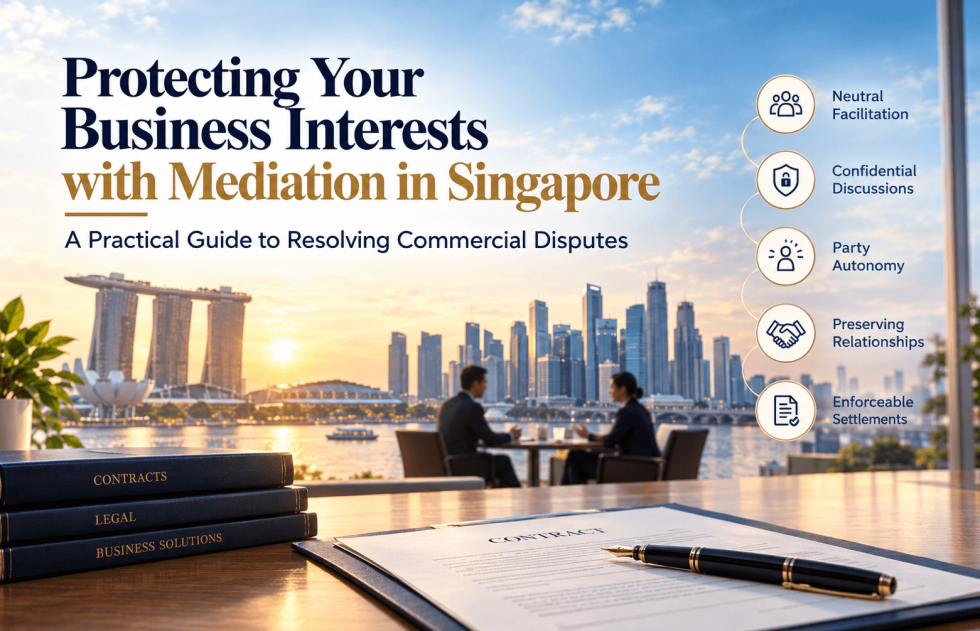
Protecting Your Business Interests with Mediation in Singapore
Imagine this: a business decides to expand overseas. The owners have done their market research, found employees who are a good fit and successfully incorporated the local subsidiary or branch office. Now it's time to form business relationships with local vendors and customers. Perhaps they decided to manage their risk of disputes by getting local lawyers to draft and review their contracts. But what do they do when there is an unhappy supplier, client or business associate? Do they want to take the risk of going to court? Do they privately settle and hope that the problem goes away?
If this happened in Singapore, and the business owners raised these concerns before entering into any transaction, my first suggestion would be to include a mediation clause in the contract. By taking this first step, the business has the opportunity to de-escalate business disputes at an early stage, and enjoy a wide range of benefits that comes with concluding settlement agreements under Singapore law.
As a preliminary point, many members of the public have this impression that mediation is a fully voluntary process, which implies that once one party no longer wants to participate, they can simply withdraw and the process terminates with no negative consequences to them. While it is true that mediation prioritises the autonomy of the parties to participate in the mediation, this is balanced against the autonomy of the parties to enter into binding contracts. Singapore courts have now decided that a contracting party is bound by a mediation clause in the contract, if the contract makes it mandatory for parties to go through mediation, and the court has the power to order the party to attend the mediation rather than simply compensating the other party for the lost opportunity (https://www.elitigation.sg/gd/s/2023_SGHC_71). So having a properly draft mediation clause ensures that the dispute does not have to start in court first.
Of course, parties are free to mediate disputes at any other time, so not having a contract with a mediation clause is not necessarily fatal. But what are the advantages of mediating a dispute?
1. Saves time and cost
In Singapore, parties in litigation can expect to only see the judge for trial at least one year after the suit has been started. There are several stages for parties to complete before the court will schedule the dispute to be tried, and it is possible for the judge to reject parties and send them back to the registry to take further instructions to better prepare for a postponed trial.
In comparison, mediation can be a fairly quick process, as long as parties have commonly available dates in the near future (which usually ends up in mediation being scheduled sometime in the next 3 months after the application is made). Most mediations in Singapore also conclude within a single day, compared to trials which may take days, weeks or even several tranches of weeks depending on the complexity of the case.
Aside from the fairly obvious conclusion that lawyer's fees would be much less if a dispute could be successfully resolved at mediation, litigation or arbitration carries the risk of having to pay the other party's legal fees if the judge or arbitrator rules in their favour. Typically a successful outcome after mediation also means that each party bears its own costs, so the economic cost-benefit analysis is much simpler since a party does not have to factor in the possibility of recovering or paying more legal costs.
2. What is said in mediation, stays in mediation
Every experienced advocate knows that a mediator will always emphasise at the start of a mediation that anything said in the course of mediation cannot be used in other proceedings, and that anything said to the mediator will remain confidential unless they are authorised to disclose it to another person. This allows parties to have a full and frank discussion of what matters to them, without fearing that the others may try to gain an advantage against them later (such as framing certain statements as admissions). This is also a major factor in a successful mediation because parties then feel free to explore various options to resolve their dispute, rather than trying to present a narrative to persuade a judge to give them the desired remedies.
3. Preserves autonomy
Aside from the fact that parties have to agree to be part of mediation, whether in the form of a written clause or an ad hoc agreement after a dispute has arisen, the mediation process is designed to give parties as much decision-making power as possible. Parties are asked to personally present their point of view in joint sessions, create proposals after they have heard each other and ultimately decide whether to compromise. Compared to litigation or arbitration where parties present their evidence and arguments, and then put the decision-making power in the tribunal's hands, mediation gives parties more control over both the process and the outcome.
4. Preserves relationships
It may be difficult for two parties to a lawsuit to continue working with each other after judgment has been given, since one party wins at the expense of the other. However mediation can preserve the relationship between the parties - whether it is a working relationship or personal relationship - since it can produce solutions where parties still work together after the mediation has ended. The mediation process helps parties to consider whether they are better off working with each other but on different terms to avoid the same problems that brought them to the negotiating table. In contrast, going to court or arbitration means taking the position that the relationship has broken down, and the tribunal is usually focused on the consequences of such a breakdown rather than restoring the relationship.
5. Creates an easily enforceable outcome
Many parties may come to mediation because the dispute has become so complex that they wish to have the chance to avoid the time and money cost of adversarial proceedings. Typically a successful mediation would produce an agreement which can be enforced as a contract, and more often than not the settlement agreement is a much simpler contract than the situation which gave rise to the dispute, resulting in reduced costs of enforcement compared to the background facts of a dispute where parties may not have properly documented their relationship.
In addition, Singapore also has other laws to support the primacy of the settlement agreement, such as the Mediation Act 2017 which allows a party to a settlement agreement to halt court proceedings in favour of the terms of the settlement agreement. Another advantage of entering into a settlement agreement for international commercial disputes under Singapore law, is that it is also enforceable under the Singapore Convention on Mediation in the courts of 20 (and increasing!) countries.
The advantage of an amicable settlement seems clear. The next question then usually is why would parties want to appoint a mediator instead of attempting to privately settle the matter between themselves?
1. The mediator is neutral
The parties and their lawyers may attempt to convene a private negotiation to attempt to settle a dispute. However if the parties relationship has broken down severely and they are not able to listen to each other with a non-judgmental mindset, it becomes difficult for parties to look beyond the negative emotions created prior to the negotiation. Having a mediator means that the parties can rely on the mediator to create a safe space for parties to talk about their underlying concerns so that they can eventually explore different solutions.
2. The mediator takes care of the process
Having attempted to organise and then run such private negotiations myself, I can say it is definitely easier to have the mediator propose the procedural flow of the meeting and to keep parties on track, so that the lawyers can focus on advising their clients. While possible, it is stressful for one party's counsel to act both as referee and coach, so I would definitely prefer to have a mediator keep track of the time and sequence of the meeting.
3. The mediator can act as the bridge between parties
Even if parties are willing to come to mediation, there are times where they may feel that they cannot disclose certain facts to the other party. The mediator then can call for a private session to see what the difficulties are and propose solutions to overcoming such reservations, so that the concerned party is still involved in the mediation process without constantly holding themselves back in a joint session.
The mediator sometimes also engages in "shuttle diplomacy", by going back and forth between the parties to help them communicate concerns and solutions in a way which might be more palatable than what the opposing party would say. This also has the effect of maintaining the safe space for each party especially where the relationship has severely broken down.
By having a contract which gives the parties an opportunity to resolve business disputes without going to court and relying on a neutral mediator to help facilitate the resolution process, business owners can avoid the uncertainty of a judge making an unfavourable decision, not to mention the significant strain on time, money and mental space of being involved in protracted adversarial proceedings. Having Singapore as your mediation seat gives you various procedural advantages so that you get the most of your settlement agreement.