READING THE NEW KUHP
A Practical Guide to the General Framework, Definitions & Special Laws
The new Indonesian Criminal Code is not merely a new list of criminal offences.
One of its most important changes is the general framework established in Book One, which provides the rules for understanding, interpreting and applying criminal law.
For business and transactional matters, this changes how a potential criminal issue should be approached.
“What offence is this?”
A better starting point is:
“Does Indonesian criminal law apply, what do the relevant terms mean, and does any special law modify the general framework?”
1. APPLY
Chapter I | Articles 1–11
The first question is whether and how Indonesian criminal law applies.
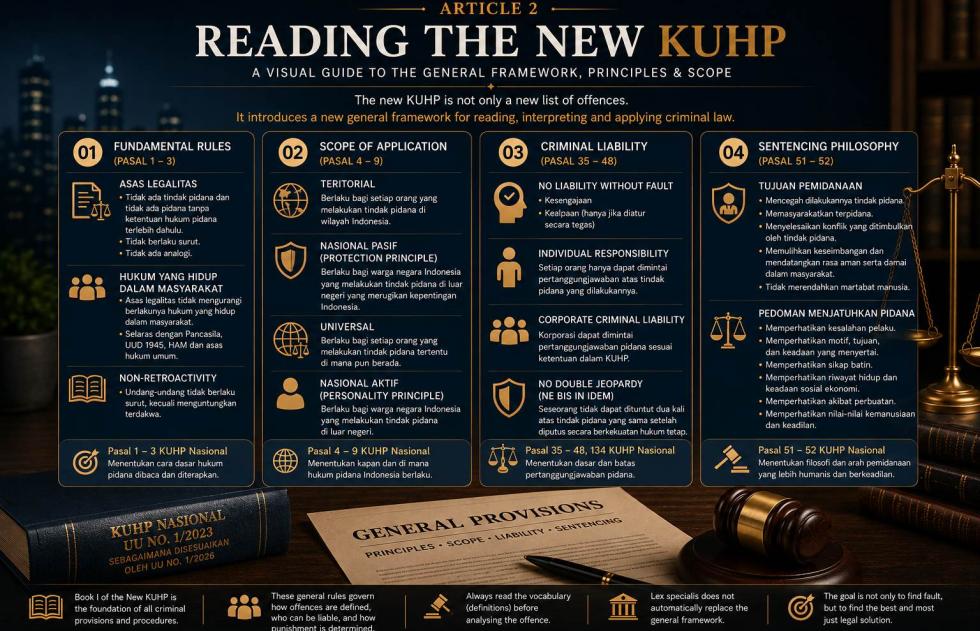
Chapter I establishes the framework concerning the scope of application of criminal legislation, including legality, changes in criminal law, living law, and the territorial and extraterritorial application of Indonesian criminal law.
Legality. Article 1 establishes the basic principle that conduct may only be punished where it has been regulated as a criminal offence before the conduct occurred. Criminal provisions may not be applied by analogy.
Living Law. Article 2 recognises the existence of living law in society, subject to the conditions and limitations established by the KUHP.
This does not mean that every customary norm automatically becomes a criminal rule. Its application remains subject to the statutory framework, including consistency with Pancasila, the Constitution, human rights and generally recognised legal principles.
Changes & Jurisdiction. Article 3 establishes the rules applicable when criminal legislation changes after the conduct occurred, including the application of the new law unless the previous law is more favourable to the perpetrator or accomplice. It also addresses the consequences where conduct is no longer criminal under the new law.
Articles 4–9 establish the framework for when Indonesian criminal law may apply to conduct occurring inside or outside Indonesia.
For business matters, this is particularly relevant because Article 5 extends protection to certain Indonesian interests, including economic, trade and banking interests.
Conduct occurring outside Indonesia does not automatically mean Indonesian criminal law is irrelevant.
The applicable connecting factor must be examined.
2. DEFINE
Chapter V | Articles 144–186
The second step is often overlooked:
“What does the relevant legal term actually mean?”
Book One contains a dedicated chapter on Pengertian Istilah / Definitions, covering Articles 144–186.
This matters because criminal liability depends on statutory elements, and those elements may depend on specific statutory definitions.
A lawyer should therefore avoid relying solely on the ordinary meaning of a word.
OFFENCE → DEFINITION → ELEMENTS → FACTS → EVIDENCE
Definitions are not merely background reading. They can determine the scope of the offence.
This becomes particularly important in commercial transactions, where the legal meaning of a particular term may materially affect whether the elements of a criminal offence are satisfied.
3. CROSS-CHECK
Chapter VI | Article 187
The final layer is particularly important when dealing with special criminal legislation.
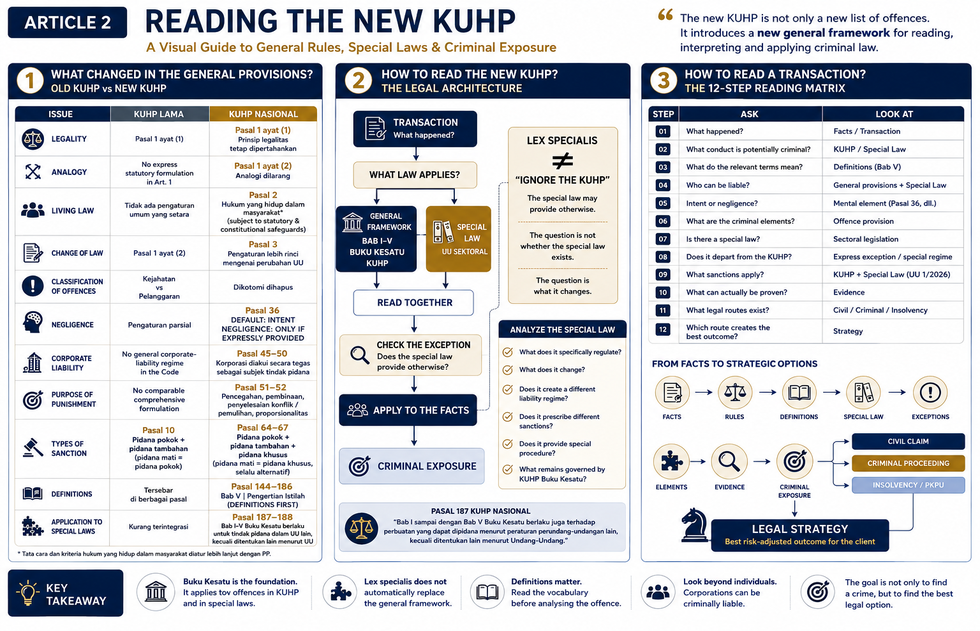
Article 187 provides that the provisions of Chapters I to V of Book One also apply to conduct punishable under other legislation, unless otherwise provided by law.
GENERAL FRAMEWORK
Book One KUHP
↓
SPECIAL LAW / LEX SPECIALIS
↓
CHECK WHAT THE SPECIAL LAW PROVIDES OTHERWISE
↓
APPLY THE COMPLETE FRAMEWORK
This is an important distinction.
Lex specialis does not simply mean “ignore the KUHP.” The general framework continues to apply unless the special legislation expressly provides otherwise.
This is particularly important when dealing with sector-specific criminal legislation and highly regulated industries.
THE PRACTICAL READING METHOD
When analysing a potentially criminal transaction, the framework can be reduced to six questions:
01 | APPLY. Does Indonesian criminal law apply?
02 | IDENTIFY. What conduct could potentially constitute an offence?
03 | DEFINE. What do the relevant statutory terms mean?
04 | CROSS-CHECK. Is there a special law, and does it provide otherwise?
05 | PROVE. What criminal elements must be established, and what evidence proves them?
06 | STRATEGISE. What legal and commercial options follow from the analysis?
APPLY → IDENTIFY → DEFINE → CROSS-CHECK → PROVE → STRATEGISE
BEYOND INSIGHT
DON’T START WITH THE OFFENCE. START WITH THE FRAMEWORK.
In a commercial dispute, the same transaction may potentially create different legal routes.
It may involve:
Civil liability
Criminal exposure
Regulatory consequences
Restructuring / PKPU considerations
Negotiation or settlement
The objective is not to criminalise every commercial dispute.
The objective is to identify the complete legal landscape before deciding which route creates the strongest risk-adjusted outcome.
That is the practical value of understanding the General Provisions of the New KUHP.
Read the framework first.
Then read the offence.
Then decide the strategy.
Sources
Law No. 1 of 2023 on the Criminal Code (KUHP), Book One, as amended by Law No. 1 of 2026 on Criminal Adjustment.