
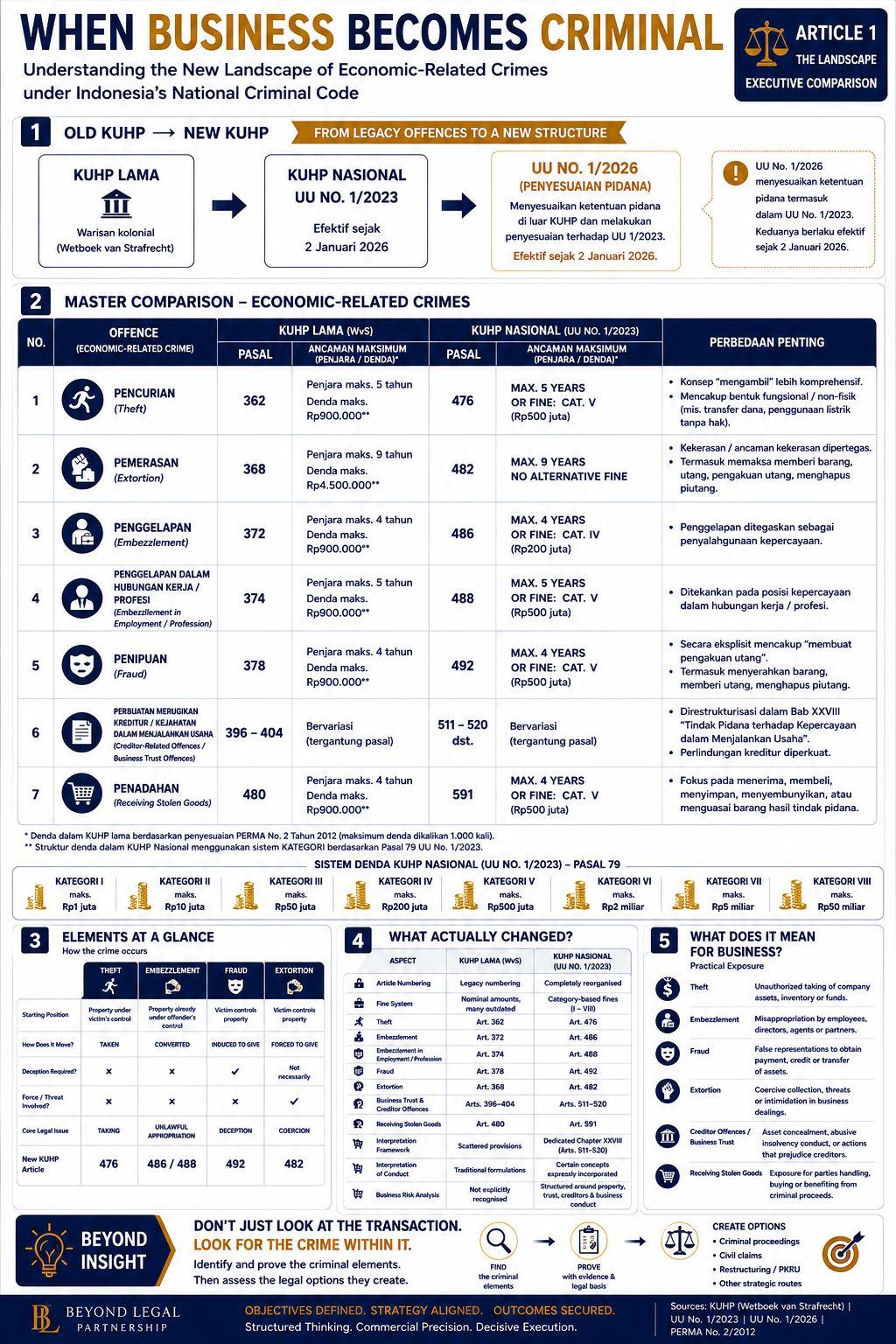
 WHEN BUSINESS BECOMES CRIMINAL
Understanding the New Landscape of Economic-Related Crimes under Indonesia’s National Criminal Code
ARTICLE 1 | THE LANDSCAPE
1 OLD KUHP → NEW KUHP
| KUHP LAMA | KUHP NASIONAL UU NO. 1/2023 | UU NO. 1/2026 (PENYESUAIAN PIDANA) |
Both the new Criminal Code and the 2026 Criminal Adjustments apply from 2 January 2026. For publication, the penalty column should be read as the current framework after reconciliation with Law No. 1 of 2026.
2 MASTER COMPARISON | ECONOMIC-RELATED CRIMES
| No. | Offence (Economic-Related Crime) | KUHP Lama Pasal | KUHP Lama Ancaman Maksimum | KUHP Nasional Pasal | KUHP Nasional Ancaman Maksimum | Perbedaan Penting |
|---|---|---|---|---|---|---|
| 1 | Pencurian (Theft) | 362 | Penjara maks. 5 tahun Denda maks. Rp900.000 | 476 | Penjara maks. 5 tahun Denda maks. Kategori V (Rp500 juta) | Konsep “mengambil” dirumuskan dalam KUHP baru; struktur sanksi denda berubah ke sistem kategori. |
| 2 | Pemerasan (Extortion) | 368 | Penjara maks. 9 tahun | 482 | Penjara maks. 9 tahun Denda sesuai kategori | Inti tetap pada pemaksaan dengan kekerasan/ancaman kekerasan untuk memperoleh keuntungan; sanksi denda mengikuti sistem kategori. |
| 3 | Penggelapan (Embezzlement) | 372 | Penjara maks. 4 tahun Denda maks. Rp900.000 | 486 | Penjara maks. 4 tahun Denda maks. Kategori IV (Rp200 juta) | Barang sudah berada dalam penguasaan pelaku bukan karena tindak pidana, kemudian dimiliki secara melawan hukum. |
| 4 | Penggelapan dalam hubungan kerja / profesi (Employment / Profession) | 374 | Penjara maks. 5 tahun Denda maks. Rp900.000 | 488 | Penjara maks. 5 tahun Denda sesuai kategori | Pemberatan karena penguasaan barang timbul dari hubungan kerja, profesi, atau pemberian upah untuk itu. |
| 5 | Penipuan (Fraud) | 378 | Penjara maks. 4 tahun Denda maks. Rp900.000 | 492 | Penjara maks. 4 tahun Denda maks. Kategori V (Rp500 juta) | Secara eksplisit mencakup membuat pengakuan utang, selain memberi utang atau menghapus piutang, melalui tipu muslihat/rangkaian kebohongan. |
| 6 | Perbuatan merugikan kreditur / Kepercayaan dalam menjalankan usaha (Creditor / Business Trust) | 396–405 | Bervariasi aut sesuai pasal | 511–dst. | Bervariasi sesuai pasal | Dikodifikasi dalam Bab XXVIII: Tindak Pidana terhadap Kepercayaan dalam Menjalankan Usaha, termasuk perlindungan kreditur. |
| 7 | Penadahan (Receiving Stolen Goods) | 480 | Penjara maks. 4 tahun Denda maks. Rp900.000 | 591–592 | Penjara maks. 4 tahun Denda sesuai kategori | Mencakup menerima, membeli, menjual, menyimpan, menyembunyikan, atau mengambil manfaat dari barang yang diketahui/patut diduga berasal dari tindak pidana. |
3 PENALTY SHIFT | PRISON VS. FINE
| KUHP LAMA | KUHP NASIONAL |
| Nominal fine amounts, many of which are outdated | Category-based fine system |
| Legacy nominal values | Category IV: Rp200 million |
| Category V: Rp500 million | |
| Category VI: Rp2 billion |
KEY TAKEAWAY:
The prison ceiling may stay the same. The financial exposure does not.
4 ELEMENTS AT A GLANCE
| THEFT | EMBEZZLEMENT | FRAUD | EXTORTION | |
| Starting position | Property under victim’s control | Property already under offender’s control | Victim controls property | Victim controls property |
| How does it move? | TAKEN | CONVERTED | INDUCED TO GIVE | FORCED TO GIVE |
| Deception required? | No | No | Yes | Not necessarily |
| Force / threat required? | No | No | No | Yes |
| Core legal issue | TAKING | UNLAWFUL APPROPRIATION | DECEPTION | COERCION |
| New KUHP Article | 476 | 486 | 492 | 482 |
5 WHAT ACTUALLY CHANGED?
| DIMENSION | KUHP LAMA | KUHP NASIONAL (UU 1/2023 jo. UU 1/2026) |
| Article numbering | Legacy numbering | Completely reorganised |
| Fine system | Nominal amounts, many outdated | Category-based fines |
| Theft | Art. 362 | Art. 476 |
| Embezzlement | Art. 372 | Art. 486 |
| Fraud | Art. 378 | Art. 492 |
| Business trust | Scattered provisions | Dedicated Chapter XXVIII |
| Creditor protection | Arts. 396–405 | Arts. 511 onwards |
| Business risk analysis | Primarily offence-based | Structured around property, trust, creditors and business conduct |
6 WHAT DOES IT MEAN FOR BUSINESS?
| OFFENCE | PRACTICAL BUSINESS EXPOSURE |
| Theft | Unauthorised taking of company assets, inventory, funds or other property. |
| Embezzlement | Misappropriation by employees, directors, agents or partners who already control the property. |
| Fraud | False representations or deception inducing payment, financing, debt transactions or transfer of property. |
| Extortion | Coercive collection, threats or intimidation in business dealings. |
| Creditor offences / Business Trust | Asset concealment, abusive insolvency conduct, or conduct prejudicing creditors. |
| Receiving stolen goods | Exposure for parties handling, buying or benefiting from criminally derived assets. |
BEYOND INSIGHT
The starting point is not to ask whether a transaction is “civil” or “criminal.”
A transaction may give rise to a civil claim. But where the underlying conduct also contains elements of fraud, embezzlement, unlawful appropriation, creditor prejudice or other criminal offences, the legal strategy may extend beyond a civil claim.
This can create multiple strategic routes: CIVIL CLAIM + CRIMINAL PROCEEDINGS + INSOLVENCY / PKPU STRATEGY, subject to the applicable statutory requirements.
The objective is not to criminalise a civil dispute for its own sake. It is to identify every legally supportable avenue available to protect the client’s interests, maximise leverage and improve the prospect of recovery.
The strategic question is: can we identify and prove criminal elements within the transaction?