
Bali Leasehold Land: What Happens After You Sign?
A 25 to 30 year lease is not a land right. Here's what decides its fate if the owner dies, the land is sold, or the lease term ends.
A leasehold is not a land right. Property agents rarely explain this clearly, and it's the root of most problems that surface later. Tenants assume they “own” the land in some other way. What they actually hold is just a lease contract.
The difference matters. Land rights are registered with the National Land Agency and protected by the state. A lease contract is not. What happens if the owner dies, or what happens once a 25 or 30 year term ends, comes down entirely to what the contract itself says.
Three things most often lead to disputes: the landowner dying, the land being sold to someone else, and the lease term ending. All three already have a legal basis. The problem is that most leasehold contracts circulating in Bali don't close the practical gaps.
Check your situation first These three questions point you to the section below that matters most for you. ☐ Were you already living in Indonesia when the contract was signed? See “What a leasehold actually is” ☐ Was it made through a notary or PPAT, not just signed on plain paper? See “The clauses your contract needs” ☐ Does it bind the landowner's heirs? See “If the landowner dies” |

What a leasehold actually is
Most explanations of leasehold stop at “it's a contract, not a land right,” as if leasehold sits entirely outside agrarian law. But Indonesia's Basic Agrarian Law, the UUPA, names a right that matches exactly what's marketed as leasehold in Bali: Hak Sewa, the lease right for buildings, set out in Articles 44 and 45, one of eight land rights the law recognises.

The difference from Hak Pakai, the Right of Use, comes down to registration. Hak Pakai must be registered with the Land Office and comes with its own certificate, now governed by Government Regulation 18/2021. Hak Sewa, although named in the same law, doesn't have to be registered. This is where leasehold reverts to being a matter of contract: recognised by agrarian law, but its protection still depends entirely on what's written down.
Article 44(1), UUPA “A person holds a lease right over land if they are entitled to use land belonging to someone else for the purpose of building on it, in exchange for paying the owner a sum of money as rent.” |
There's one condition an agent's pitch often leaves out. This lease right is only available to foreigners already residing in Indonesia (Article 45), not to any foreign buyer. In practice, plenty of leaseholds get signed by buyers who aren't yet living in the country, tourists who are just starting to consider the move. The contract is still valid, but it falls back to being an ordinary lease under the Civil Code, without the UUPA's added protection.
There's also a built-in protection tenants rarely notice. Article 44(3) of the UUPA bans lease agreements from containing terms with elements of extortion. A disproportionate penalty, or one far beyond the landowner's actual loss, can potentially be struck down on this basis.
What matters in practice: whether the contract counts as Hak Sewa under the UUPA or an ordinary lease under the Civil Code, the outcome is much the same. Most land leases in Indonesia are never formally registered. The owner is still bound, because a valid agreement is binding on the parties to it, but if the contract itself is weak on the three points below, no legal label can rescue the tenant's position.
If the landowner dies
The landowner's death doesn't cancel a lease that's already running. Their heirs automatically step into the owner's position, including the duty to honour the remaining term.
Article 1575, Indonesian Civil Code “A lease agreement does not end with the death of either the landlord or the tenant.” |
The problem shows up in practice. Many Bali leaseholds are private agreements that were never formally disclosed to the eventual heirs. When the owner dies, heirs who didn't know the contract existed can dispute its validity, especially if they're already in conflict over the wider estate. The law protects the tenant, but proving that to heirs who are disputing it is its own long, costly process.
The fix belongs in the contract itself, summed up under “the clauses your contract needs” below.
If the land is sold to someone else
The same principle applies here. If the land is sold during the lease term, the new buyer automatically takes over the previous owner's position, including the duty to honour the tenant's remaining term.
Article 1576, Indonesian Civil Code “The sale of leased property does not terminate an existing lease, unless this was agreed at the time the lease was granted.” |
This article has one loophole, and it's the one most often abused. The protection applies unless the contract says otherwise from the outset. If the contract includes a clause stating the lease ends once the land is sold, the tenant loses this protection entirely. Clauses like this are rarely written in plain sight, they tend to be tucked into other terms that look purely administrative.
This is something to check yourself before signing, not something to assume is safe just because “there's an article that protects it.”
If the lease term has ended
Unlike the two situations above, no article automatically governs what happens once a 25 or 30 year lease term ends. It's purely a matter of what the contract agreed to, under Article 1338 of the Civil Code. If the contract is silent on this, the tenant has no right to demand renewal or compensation.
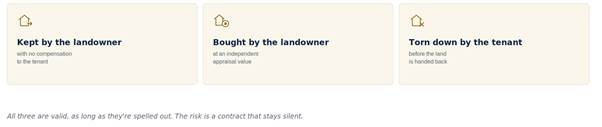
The first common dispute is the renewal price. A clause that just says “renewable at the market price at the time” is close to useless, since it turns into a renegotiation from zero rather than an enforceable right. The second is the status of any building the tenant put up on the leased land. There are three approaches commonly used:
The clauses your contract needs
Based on everything above, these are four clauses that should never be missing from any leasehold contract.
1. Binding the heirs. the agreement explicitly binds the landowner's heirs and successors, not just the person who signed.
2. Reaffirming Article 1576. no hidden exception that lets the lease end automatically once the land is sold.
3. A clear renewal mechanism. a defined pricing formula, not just “market price at the time,” plus a notice period.
4. Building status at the end of the lease. decided upfront: kept by the landowner, bought at appraisal, or torn down.
All four are far stronger when set out in a deed made through a notary or PPAT (land deed official), rather than a plain signed agreement. A notarial deed provides a fixed date and evidence that's far harder for heirs or a new buyer to dispute. If your contract is currently the latter, this is the cheapest thing to fix before a dispute happens.
Closing thoughts
Leasehold in Bali isn't a risky scheme by nature. Thousands of foreigners have used it without issue for decades. What makes it risky is a contract signed in a hurry, often just an agent's standard template that leaves the gaps above wide open.
Haven't signed yet? Take the draft contract to a legal adviser before, not after, the deposit is paid.
Already holding an older contract? Read it again against the four points above, especially if it's a private agreement that's never been reviewed since it was signed. Fixing a contract that's already running is still possible through an addendum, and it's far easier to do before a dispute arises than after.
Frequently asked questions
Is leasehold legal for foreigners in Bali?
Yes. Because it takes the form of a lease contract rather than a land right, leasehold doesn't run into the UUPA's restriction of freehold ownership to Indonesian citizens.
Is leasehold the same as the Hak Sewa the UUPA sets out?
It can be, or it may not be. If the tenant is a foreigner already residing in Indonesia, the contract falls under Hak Sewa per Articles 44 and 45 of the UUPA. If not, the contract is still valid, but sits purely under the Civil Code as an ordinary lease.
Does an unregistered leasehold contract still hold up?
Yes, because a valid agreement is binding on the parties to it. But it's far harder to prove than a contract made through a notary and properly documented.
Can a leasehold be passed on to my children?
Yes, as long as the contract doesn't explicitly rule it out. This is a contractual right, so it follows whatever the parties agreed to, not the automatic inheritance rules that apply to land rights.
Does the lease automatically end if the land is sold?
No, unless the contract states otherwise from the start. This is worth checking before you sign.
Before you sign or renew a contract Talk to the team at Beyond Legal Partnership about your leasehold clauses before a problem shows up later. |
This article is general in nature and written for educational purposes. It is not a substitute for direct legal advice on your specific situation.
Beyond Legal Partnership