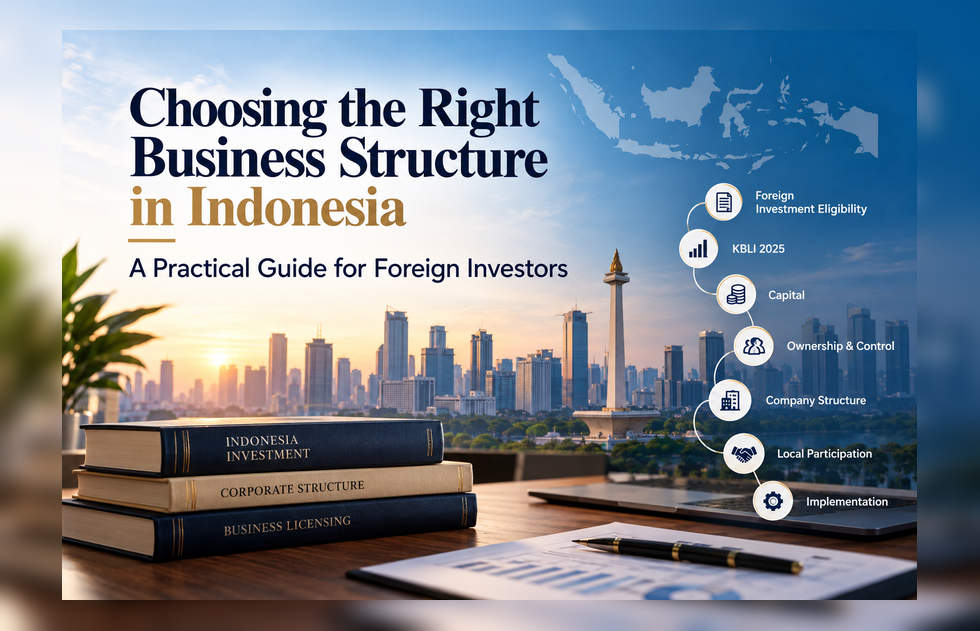
Choosing the Right Business Structure in Indonesia: A Practical Guide for Foreign Investors
A practical decision framework for foreign investment, business setup, ownership, control, corporate structure, local participation and post-establishment requirements in Indonesia.
How Do Foreign Investors Choose the Right Business Structure in Indonesia?
For foreign investors, setting up a business in Indonesia involves more than incorporating a company.
Before proceeding with company incorporation, an investor should first determine whether the proposed business activity is open to foreign investment, identify the applicable KBLI 2025, assess foreign ownership and investment requirements, determine the desired level of control, and select the appropriate corporate structure.
Depending on these factors, the appropriate structure may involve a PT PMA, a PT PMA with an Indonesian local partner, a PT Local where legally and commercially appropriate, or another suitable market-entry structure.
This article provides a practical framework for moving from the investor's business objectives and regulatory position to the appropriate business structure in Indonesia.
Key principle: The right structure should follow the business facts and regulatory position, not the other way around.
How to Use This Framework
This is a legal and commercial decision sequence, not a second questionnaire. The investor's business facts should already have been identified through the preliminary assessment. The framework then translates those facts into the appropriate Indonesian structure and the legal and operational work that follows.
Foreign Investment Eligibility → KBLI 2025 → Capital → Ownership & Control → Company Structure → Local Participation → Implementation
Step 1. Check the Positive List
Can a Foreign Investor Own 100% of a Business in Indonesia?
The first question is whether the proposed business activity can be 100% foreign-owned, is subject to a foreign ownership limitation, or is closed to investment.
Investment is generally open unless the relevant business activity is subject to a specific limitation or is closed to investment.
Illustrative Examples
| FOREIGN INVESTMENT TREATMENT | ILLUSTRATIVE EXAMPLES |
| 100% FOREIGN OWNERSHIP | Wholesale Trading (e.g. machinery, equipment, consumer goods) Management Consulting (e.g. business strategy, management, organisational consulting) |
| FOREIGN OWNERSHIP SUBJECT TO LIMITATION | Courier Services Domestic Sea & Air Transportation Defence-Related Industries |
| CLOSED TO INVESTMENT | Alcoholic Beverage Manufacturing (including liquor, wine and malt beverages) |
These examples are illustrative only and should be checked against the applicable KBLI and current sector-specific rules before publication or client reliance.
Legal reference: Presidential Regulation No. 10 of 2021, as amended by Presidential Regulation No. 49 of 2021.
Step 2. Confirm the KBLI 2025
What Is KBLI 2025 and Why Does It Matter?
The KBLI 2025 identifies the exact business activity of the proposed business and is a key reference for determining the applicable licensing and regulatory requirements.
Business Activity → KBLI 2025 → Foreign Investment Treatment → Licensing & Regulatory Requirements
The Positive List determines the applicable foreign-investment treatment, while the KBLI identifies the relevant business activity. Importantly, a 100% foreign-ownership position does not mean that the business is free from licensing or sector-specific requirements. Where foreign ownership is limited, the applicable ownership restriction must be assessed together with the requirements applicable to the specific business activity.
Legal reference: Peraturan Badan Pusat Statistik No. 7 Tahun 2025 concerning Klasifikasi Baku Lapangan Usaha Indonesia (KBLI 2025).
Step 3. Assess the Commercial Parameters
A. Capital
How Much Capital Are You Willing to Inject?
Under the current PMA framework reflected in this guide, the general threshold is:
• Total investment value: more than IDR 10 billion, excluding land and buildings, per relevant 5-digit KBLI per project location, subject to applicable exceptions; and
• Minimum issued and paid-up capital: IDR 2.5 billion per PT, subject to applicable rules.
Investment Value Is Not the Same as Paid-Up Capital
This distinction is important.
The IDR 10 billion investment-value threshold and the IDR 2.5 billion paid-up-capital requirement are different concepts and should not be treated as the same calculation or automatically multiplied by the number of KBLI. The applicable requirements should be assessed against the specific business activity, structure and applicable regulatory framework.
B. Control
How Much Control Do You Need?
100% ownership → full ownership position
Majority ownership → majority position, subject to the applicable ownership limit and governance structure
Minority ownership → assess the lawful governance and control rights available to the investor
A full ownership position, where legally permitted.
Majority ownership
A majority position, subject to the applicable ownership limit and governance structure.
Minority ownership
Assessment of the lawful governance and control rights available to the investor.
The appropriate structure should therefore consider not only how much the investor can own, but also how much control the investor commercially requires and can lawfully exercise.
Step 4. Determine the Company Structure
What Company Structure Should a Foreign Investor Use in Indonesia?
Once the foreign-investment position, KBLI, capital and control requirements have been assessed, the investor can determine the appropriate company structure in Indonesia.
A. PT PMA
A PT PMA, or Foreign Direct Investment Company, is the principal corporate structure considered for foreign direct investment in Indonesia, subject to the applicable rules.
1. 100% PT PMA
Where 100% foreign ownership is permitted, the foreign investor may directly own the Indonesian company.
2. PT PMA with an Indonesian Local Partner
Where foreign ownership is limited and cannot reach 100%, the foreign investor holds the maximum permitted percentage, and the required balance is held by the Indonesian partner. This structure requires careful consideration of ownership, governance, decision-making, economic interests and the broader commercial relationship between the parties.
B. PT Local
A PT Local, meaning a 100% locally owned Indonesian company, may be relevant where the investor does not require direct foreign equity participation, including certain market-testing scenarios, provided that the business model and structure are legally and commercially legitimate.
Important: Avoid Nominee Structures
A PT Local should not be presented or used as a mechanism to circumvent foreign-ownership restrictions. Any nominee or similar arrangement raises separate legal and enforcement risks and should be assessed independently.
Step 5. Determine Whether an Indonesian Local Partner Is Required
Does a Foreign Investor Need an Indonesian Local Partner?
The answer depends on the foreign-ownership rules applicable to the relevant business activity.
Where the business does not allow 100% foreign ownership, Indonesian participation is required.
1. Existing Indonesian Partner or Indonesian Affiliate
Where an existing Indonesian partner or affiliate is available, the investor should assess:
• the existing relationship;
• legal capacity;
• commercial alignment;
• due diligence;
• governance; and
• ownership structure.
2. Finding a Suitable Local Partner
Where a new Indonesian partner is required, the process should generally move through:
Identify → Due Diligence → Negotiate → Structure → Document
Finding a local partner should therefore not be treated simply as finding a shareholder. The relationship should be assessed as part of the broader corporate and commercial structure.
Step 6. Assess Post-Establishment Requirements
What Happens After the Structure Is Determined?
Determining the investment and corporate structure is not the end of the process.
Additional legal and operational requirements should be assessed according to the specific business activity.
1. Special Permits and Sector-Specific Requirements
Does the business require additional licenses, approvals, certifications, or sector-specific permits?
2. Immigration
Will the foreign investor, director or personnel require Indonesian immigration status, including KITAS where applicable?
3. Foreign Workers
Will foreign personnel actually work in Indonesia? If so, the applicable foreign-worker and employment requirements should be assessed.
4. Tax
What Indonesian tax implications arise from the chosen structure and business model?
5. Trade / Import-Export
Where relevant, does the business import, export or distribute goods in Indonesia?
6. Other Operating Requirements
Depending on the business, additional requirements may relate to land and premises, environmental matters, employment, data, intellectual property, and other sector-specific compliance.
How Do Foreign Investors Set Up a Business in Indonesia?
In practical terms, the process should not begin with incorporation paperwork alone.
A foreign investor should first:
- Check whether the business is open to foreign investment
- Identify the correct KBLI 2025
- Assess foreign ownership restrictions
- Determine investment and capital requirements
- Determine the required level of ownership and control
- Choose the appropriate company structure
- Determine whether an Indonesian local partner is required
- Assess licensing and post-establishment requirements
This sequence helps ensure that company incorporation in Indonesia follows the appropriate business and legal structure, rather than treating incorporation as the starting point of the analysis.
The Indonesia Business Structure Decision Map
1. Positive List: Can the business be 100% foreign-owned?
↓
2. KBLI 2025: What exactly is the business activity and what requirements apply?
↓
3. Commercial Parameters: How much capital will be invested and how much control is desired?
↓
4. Company Structure: PT PMA, PT PMA with an Indonesian partner, PT Local, or another legally appropriate structure?
↓
5. Local Partner: If Indonesian participation is required, is there an existing partner or affiliate, or does a suitable partner need to be identified?
↓
6. Implementation: What special permits, immigration, foreign-worker, tax, trade and other operating requirements apply?
This is the practical sequence from foreign investment eligibility to business structure and implementation in Indonesia.
Frequently Asked Questions
Can a foreign investor own 100% of a business in Indonesia?
It depends on the proposed business activity and the applicable foreign-investment rules. Some activities may permit 100% foreign ownership, while others may impose foreign-ownership limitations or be closed to investment.
What is a PT PMA in Indonesia?
A PT PMA is a foreign direct investment company established in Indonesia, subject to the applicable foreign-investment, corporate and licensing requirements.
Does a foreign investor need an Indonesian local partner?
Not necessarily. Whether Indonesian participation is required depends on the business activity and applicable foreign-ownership rules.
What is KBLI 2025?
KBLI 2025 is Indonesia's classification system for economic activities. Identifying the appropriate business activity and KBLI is important because the classification can affect the applicable licensing and regulatory framework.
What should a foreign investor consider before choosing a business structure in Indonesia?
The investor should first understand the proposed business activity, foreign-investment eligibility, ownership and control requirements, operating requirements and commercial objectives. These factors provide the basis for assessing the appropriate structure.
Is company incorporation the first step for a foreign investor?
Not necessarily. The appropriate business structure should first be assessed against the business activity, foreign-investment position, KBLI, capital, ownership, control and applicable operating requirements.
Conclusion
For foreign investors, choosing the right business structure in Indonesia is a strategic decision, not simply an incorporation exercise. The appropriate structure depends on the interaction between:
Business Activity → KBLI 2025 → Foreign Investment Eligibility → Capital → Ownership → Control → Corporate Structure → Local Participation → Implementation
A structure that is legally available may not necessarily be the structure that best serves the investor's commercial objectives. The objective should therefore be to identify a structure that is legally permissible, commercially appropriate and capable of supporting the investor's intended operations and long-term objectives in Indonesia.
Key Legal References
- Presidential Regulation No. 10 of 2021 on Investment Business Fields, as amended by Presidential Regulation No. 49 of 2021.
- Presidential Regulation No. 49 of 2021 on the Amendment to Presidential Regulation No. 10 of 2021 on Investment Business Fields.
- Government Regulation No. 28 of 2025 on Risk-Based Business Licensing.
- Peraturan Badan Pusat Statistik No. 7 Tahun 2025 on Klasifikasi Baku Lapangan Usaha Indonesia (KBLI 2025).
- Peraturan Menteri Investasi dan Hilirisasi/BKPM No. 5 Tahun 2025 on Guidelines and Procedures for Risk-Based Business Licensing and Investment Facilities through the OSS system.Legal Verification Note
This framework is a practical decision guide. Sector-specific ownership limits, licensing requirements, investment thresholds, transition rules and implementation requirements must be verified against the regulations and systems applicable to the specific business activity, KBLI and location at the time of advice.