Moving to Indonesia for Good
Most people planning to move to Indonesia for good focus on two things: getting a visa, and buying a house. That makes sense, both have to happen before anything else can. But there's one moment almost nobody plans for, even though it's the moment that really tests whether the move was actually thought through: the day one partner dies.
Here's an example. Picture a retired couple, one Australian and one Dutch, who spent their last ten years together in a small house outside Ubud. They did everything right. The house was bought through a Hak Pakai, a Right to Use title, in the husband's name, since he held the main retirement visa. His wife lived in Indonesia on a visa that depended on his. For years, none of this caused any trouble. Then one morning, he died of a heart attack.
What happened next had nothing to do with a messy inheritance fight. The inheritance side of things was actually simple. The real problem came from somewhere nobody expected: his wife's own visa status. Legally speaking, it ended the moment her husband's life did.
Two Systems That Never Talk to Each Other
To see why this happens, you have to look at two separate legal systems side by side. Neither one was built with the other in mind.
The first is immigration law. Indonesia's visa for elderly foreign residents was overhauled in 2023, then adjusted again in 2024. Under the old rules, from 2014, you could apply from age 55, but you needed a long list of proof: a pension, health and life insurance, housing, even proof that you'd hired Indonesian domestic staff. The new rules simplified all of that down to one thing: proof of income of at least USD 3,000 a month. In exchange, the minimum age went up, from 55 to 60. This visa is often called Silver Hair. Officially, it's coded E33A, and it lasts 5 or 10 years.
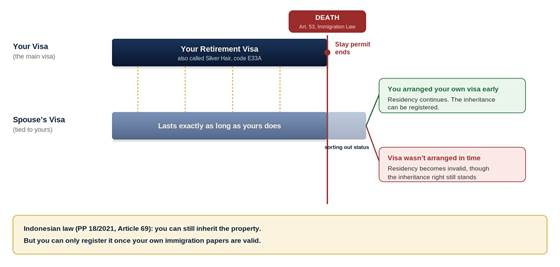
When both partners in a couple are foreign nationals, usually only one holds this main visa, called the principal. The other joins on a dependent visa, coded E31B. The rule is simple: one visa per person, and the dependent's visa lasts exactly as long as the principal's, whether that's 1, 2, 5, or 10 years. As long as the principal is alive and their visa is valid, the dependent is fine. The moment the principal is gone, so is the legal basis for the dependent's visa.
The second system is land law. This is covered in full in a separate article on property rules for foreign nationals in Indonesia, so here's the short version: a house is held through a Hak Pakai, and an apartment through a strata title called Hak Milik atas Satuan Rumah Susun. Either one can be passed down to an heir. But if that heir is also a foreign national, the law says they need valid immigration papers of their own before they can register the inheritance.
Now put the two systems next to each other. Indonesia's Immigration Law is direct about this: a stay permit ends when its holder dies. That's Article 53 of Law Number 6 of 2011, plain and simple. The moment the principal dies, the dependent visa attached to it stops being valid too. At the same time, land law says the heir needs valid immigration papers to register what they've inherited. Neither rule is wrong. They just don't wait for each other, and neither one says how much time a grieving spouse actually has to sort out their own status.
To be clear: the wife in our example never lost her right to inherit the house. What she risked losing was the ability to act on that right, because doing so depended on immigration papers that were, at that exact moment, the most fragile thing she had.
This Isn't a “Mixed Marriage” Problem
It's worth being clear that this isn't a risk for every mixed-nationality couple. If your spouse is Indonesian, the story looks completely different. Indonesian citizens never need a visa to live in their own country, so there's no residency status that can expire. The law even lets an Indonesian spouse hold full ownership (Hak Milik) or a building right (HGB) in their own name, as long as there's a marital property agreement in place. And since a 2016 Constitutional Court ruling, that agreement can be signed at any point in the marriage, not just before the wedding.
The risk in this article is specific to one situation: a couple where both partners are foreign, one as the principal visa holder and the other as their dependent. As more foreign retired couples choose to settle together in places like Bali, Yogyakarta, or Jakarta, this exact situation is becoming more common, even though almost nobody talks about it.
| Criteria | If Your Spouse Is Indonesian | If Your Spouse Is Also Foreign |
|---|---|---|
| Spouse's residency status | Citizen, no visa required | Dependent (E31B), tied to your visa |
| Right to the property | Can hold Hak Milik/HGB independently (Article 70, PP 18/2021) | Inherits Hak Pakai, requires valid immigration documents |
| Risk if you pass away | Low, residency status unaffected | A tight window to secure a new visa |
| What to prepare | Marital property agreement (anytime, per Constitutional Court Decision 69/2015) | Independent visa, a will, and a succession plan |
What You Can Actually Prepare For
Nothing can change the rule that death ends a stay permit. What can change is how ready the surviving spouse is when that day comes.
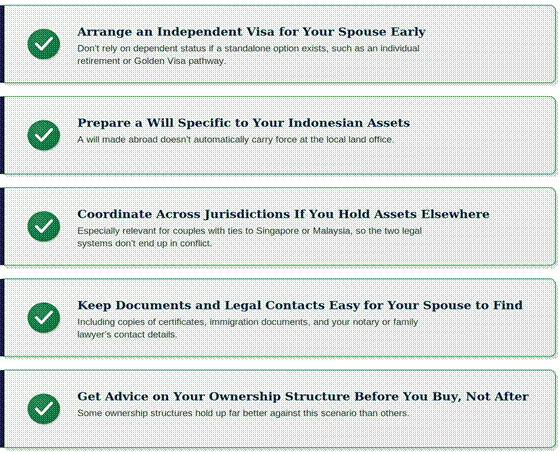
Back to the couple in Ubud. If the five steps above had been in place before that morning, the story could have gone very differently. The wife wouldn't have had to race against the clock while grieving, because her own visa would already be secure, her will would already be clear, and she'd know exactly who to call. That's the real difference between moving to Indonesia for good as a plan you've actually thought all the way through, and simply moving there and hoping for the best.
Plan Before Anyone Is Grieving If you and your spouse are both foreign nationals settling permanently in Indonesia, especially if you hold assets or family ties in other countries, it's far cheaper and far calmer to plan your succession now than to sort it out later while grieving. Beyond Legal Partnership helps structure property ownership, draft wills that work across borders, and find visa options built to handle exactly this kind of situation. |
Legal Basis
- Government Regulation Number 18 of 2021, Articles 69 and 70
- Law Number 6 of 2011 on Immigration, particularly Article 53
- Regulation of the Minister of Law and Human Rights Number 22 of 2023 on Visas and Stay Permits, as amended by Regulation Number 11 of 2024
- Regulation of the Minister of Law and Human Rights Number 27 of 2014 (pre-2023 elderly visa rules, for comparison)
- Constitutional Court Decision Number 69/PUU-XIII/2015
Frequently Asked Questions
Does a foreign spouse automatically lose their right to the house if their partner dies?
No, and this is the part people get wrong most often. The right to inherit doesn't disappear. It's fully protected under Article 69 of PP 18/2021, the same as any other inheritance. What's actually at risk is something else: the surviving spouse's ability to register that inheritance, because doing so requires currently valid immigration papers. If their visa status has already lapsed by the time they try to register, that's where things get complicated, not because of the inheritance itself.
How long is the grace period usually given after a KITAS holder dies?
Here's something worth correcting: there is no fixed number written into any regulation. Article 53 of the Immigration Law simply says a stay permit ends on death. It doesn't say how much time the surviving spouse gets to sort things out. The “30 to 60 days” figure you'll see online is just a rough estimate of how things tend to work in practice, not a legal guarantee. Because there's no certainty, the smart move is to report the death and get advice immediately, rather than counting on a number that might not apply to your situation.
What if the couple's child is also a foreign national?
The same logic applies to children. A child on a dependent visa, usually coded E31E, is tied to their parent's status. If the parent holding the principal visa dies, the child's visa is affected too. As an heir, that child also needs valid immigration papers to register their share of the inheritance. It gets more complicated if the child is a minor, since arranging a visa or guardianship for a child usually takes extra steps, and those are best sorted out well in advance.
If the spouse doesn't manage to sort out a new visa in time, is the house lost?
Not automatically, but it lands in a grey area. Nobody seizes the house or hands it back to the state just because a visa was late. What happens instead is that registering the inheritance in the spouse's name can stall until their immigration status is sorted out, whether through a new visa or another route. This is exactly the kind of grey area that's much easier to avoid through planning than to fix after the fact, because handling visa paperwork while grieving is far harder than handling it while everything's still fine.
Can both spouses become principal visa holders in their own right, so neither is a dependent?
Yes, and it's one of the most straightforward fixes available. If both partners independently qualify by age and income for a retirement or Golden Visa, both can apply as principals instead of one riding on the other's visa. The downside is cost: you're paying for two visas instead of one, and each person has to meet the income requirement on their own, which isn't always easy for a retired couple. But weighed against losing valid residency at the worst possible moment, most people find the extra cost worth it.
What if the property is held through a PT PMA (foreign investment company) instead of a personal name?
This is a different situation altogether. A Hak Pakai held by a company like a PT PMA doesn't end just because one shareholder dies, because a company keeps existing independently of the people who founded it. What changes hands isn't the land right itself, but the shares in the company, and that can be planned for in advance through a shareholders' agreement. That said, this structure tends to suit commercial ownership better than a personal home, and it comes with higher yearly compliance costs, so it's a decision worth making before you buy, not after.
Does a will made in your home country automatically apply to assets in Indonesia?
No, not automatically. A will made in another country, say Australia or the Netherlands, usually has to go through its own recognition process before it can be used to register land rights in Indonesia, and that process can take much longer than if you'd had a will drafted specifically with Indonesian law in mind. If you hold assets in more than one country, including ties to Singapore or Malaysia, it's usually safer to have two wills that reference each other clearly: one for your Indonesian assets, and one for everything else, so they don't end up contradicting one another.
Is the risk the same if the spouse with dependent status dies first, rather than the principal?
No, and this is often misunderstood. The risk in this article only applies when the principal visa holder dies, because it's the dependent visa that loses its legal basis. If the dependent spouse dies first, the principal's own visa isn't affected at all, since it was never tied to anyone else's. This asymmetry is exactly why it matters to know, in your own relationship, who holds the principal visa and who's the dependent. That's what determines who's actually at risk.
Written by Karina Permatasari Ketaren, S.H., M.Kn., CPM, Beyond Legal Partnership