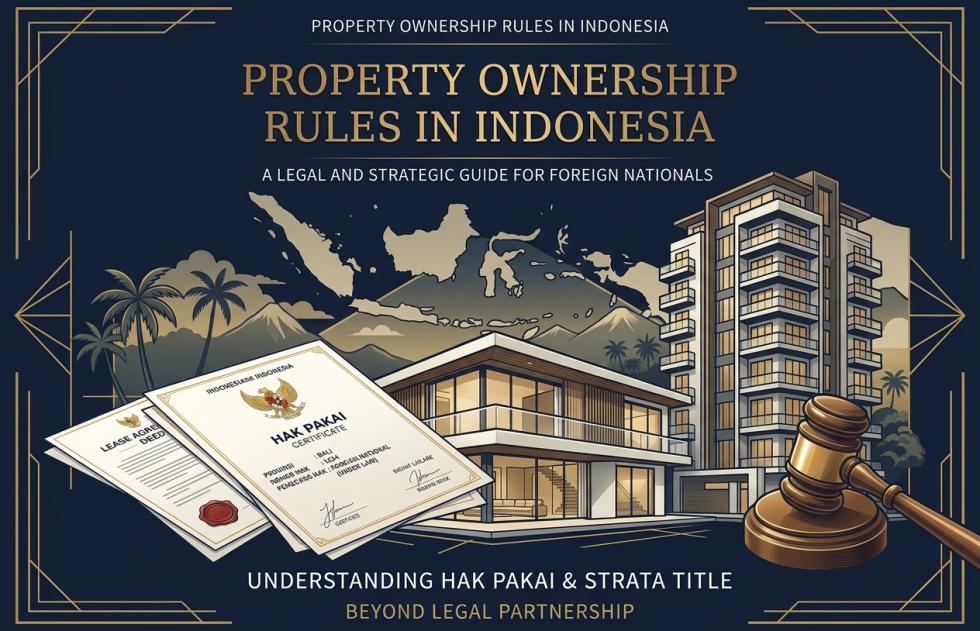
Property Ownership Rules for Foreigners in Indonesia
People often ask “can foreigners own a home in Indonesia?” But that's not quite the right question. The real answer is: yes, just not through full ownership, or Hak Milik. That distinction matters. It decides whether the property you buy is actually protected by law, or at risk of being lost down the road.
Foreign nationals can never hold a Hak Milik certificate, Indonesia's full ownership title, no matter how much they pay or how much they contribute to the economy. For a landed house, foreigners can only hold Hak Pakai, a Right to Use title. For an apartment, it works through Hak Milik atas Satuan Rumah Susun (a strata title), sitting on land held under Hak Pakai or Hak Guna Bangunan (a building right). This isn't a loophole or an oversight. It comes straight from the nationality principle built into Indonesia's Basic Agrarian Law.
The Legal Basis: From the 1960 Agrarian Law to PP 18/2021
The basic rule goes back to 1960. Law Number 5 of 1960, Indonesia's Basic Agrarian Law, splits land rights into seven types. Full ownership, cultivation rights, and building rights can only be held by Indonesian citizens or Indonesian legal entities. Foreigners get two options: Hak Pakai and Hak Sewa (a lease right).
The rules for how this works in practice have changed a few times: Government Regulation 41 of 1996, then 103 of 2015, and now Government Regulation 18 of 2021, covering management rights, land rights, strata units, and land registration. It comes out of the Job Creation Law (originally Law 11/2020, now Law 6/2023). The details are spelled out further in Ministerial Regulation 18 of 2021, Chapter VIII, Articles 185 to 188.
Here's how it works: a foreigner with valid immigration papers, whether that's a visa, a passport, or a stay permit, can own a home in one of two forms:
- A landed house, held through Hak Pakai on state land, or Hak Pakai on land someone else owns as Hak Milik or a management right, arranged through a notarial deed.
- An apartment, on land held as Hak Pakai or Hak Guna Bangunan, whether that land sits on state land, a management right, or someone's Hak Milik.
The legal basis is Article 69(1) of PP 18/2021, together with Article 185 of Ministerial Regulation 18/2021. And since PP 18/2021 took effect, the order of things flipped too. Foreigners used to need a KITAS or KITAP before they could even buy. Now a passport or visa is enough to buy, and the KITAS or KITAP can be arranged after ownership is already in place.
The Requirements and Limits That Apply
There are three limits for a landed house, set out in Article 186 of Ministerial Regulation 18/2021 and Article 72 of PP 18/2021:
- It has to be in the luxury home category, as defined under the rules in force.
- One plot per person or family.
- A maximum land size of 2,000 m².
For an apartment, the requirement is that it falls under the commercial strata category, not a subsidized one.
If a foreigner wants more than one plot, or land larger than 2,000 m², that's still possible, but it takes special permission from the Minister of Agrarian Affairs, backed by proof of a positive impact on the economy and society. There's one exception: representatives of foreign states and international bodies aren't bound by these limits.
What's the Minimum Price for Property a Foreigner Can Buy?
This is the question people ask most. The rule comes from Ministerial Decree 1241/SK-HK.02/IX/2022, in force since September 2022. The price depends on two things: which province, and what type of property, a house or an apartment. Here's both side by side so they're easy to compare:
| Province | Landed House | Apartment |
|---|---|---|
| DKI Jakarta | IDR 5 bn | IDR 3 bn |
| Banten, West/Central/East Java, Yogyakarta, Bali | IDR 5 bn | IDR 2 bn |
| West Nusa Tenggara | IDR 3 bn | IDR 1 bn |
| North Sumatra, East Kalimantan, South Sulawesi, Riau Islands | IDR 2 bn | IDR 1 bn |
| All other provinces | IDR 1 bn | IDR 1 bn |
For diaspora members (former Indonesian citizens), the threshold drops to 75% of the figures above.
There's no explicit penalty for buying below the minimum, but in practice, a transaction that doesn't meet the threshold risks getting rejected when it's registered with the land office. Because this figure comes from a ministerial decree, not a law, the government can update it at any time, so always check you're using the current number before committing to anything.
How Long Can a Foreigner Actually “Own” the Property?
A lot of people assume this is permanent ownership. It isn't. Hak Pakai works more like a long-term lease than absolute ownership, and how long it lasts depends on which kind of land it sits on.

If the land is state land or a management right, the most common path, the rule is straightforward: 30 years to start, extendable by 20 years, then renewable for another 30. If the whole cycle runs out without being renewed, the land goes back under direct state control.
If the land belongs to someone else, say a foreigner is granted Hak Pakai over land that's privately owned, the rule works a little differently: just 30 years, then renewed through a fresh deed, without the 20-year extension step used on state land.
While it's valid, this Hak Pakai can be used as loan collateral, passed down as inheritance (as long as the heir is also a foreigner with valid immigration papers), and sold on. But it's worth remembering: this is ownership with an expiration date, not the permanent kind that comes with Hak Milik.
The Nominee Trap: Why It's Not a Safe Shortcut
This is where a lot of foreigners, and the people helping them, take what looks like the easier road but turns out to be the riskiest one: a nominee arrangement. Here's how it works. Land held as Hak Milik gets bought in an Indonesian citizen's name, backed by a private agreement stating the foreigner is the real owner.
The problem is, Indonesian courts have rejected this approach again and again. The Denpasar High Court once ruled (Decision Number 68/Pdt/2021/PT.DPS) that freedom of contract has its limits, and still has to comply with the law and public order. Because of that, a nominee agreement designed to get around the ban on foreign land ownership is void, as if it never existed. The Denpasar District Court put it even more bluntly (Decision Number 787/Pdt.G/2014/PN.DPS): this is a form of legal circumvention. In a separate land dispute in Bali, the Supreme Court (Decision Number 3403 K/Pdt/2016) voided every supporting document behind a nominee scheme at once, from the lease agreement to the debt acknowledgment to the power of attorney.
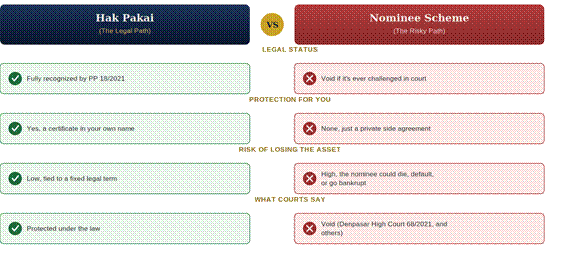
So while the Hak Pakai route feels more complicated upfront, it's the only one that actually protects a foreigner under the law.
If Your Spouse Is Indonesian
For foreigners married to an Indonesian citizen, there's an extra path that often gets missed. Your Indonesian spouse can still hold the same land rights as any other Indonesian citizen, as long as that right isn't joint marital property (the legal basis is Article 70 of PP 18/2021). The only requirement is a marital property agreement made in front of a notary.
The rule changed in 2016. Before that, a marital property agreement had to be signed before or right at the wedding. Constitutional Court Decision Number 69/PUU-XIII/2015, dated 27 October 2016, changed that. Couples can now sign this agreement at any point in the marriage, get it notarized, then register it with the civil registry office.
Golden Visa: A Property-Based Path to a Longer Stay
For foreigners thinking of property as part of a longer-term plan to stay in Indonesia, ownership also connects to the Golden Visa scheme (Ministerial Regulation 22/2023). For an individual investor not setting up a company in Indonesia, that investment can go toward property, government bonds, public shares, or a deposit, at USD 350,000 for a 5-year visa, or USD 700,000 for 10 years. This isn't a replacement for the ownership rules above. The minimum prices per province and the limits on the type of right still apply.
The Practical Steps to Buying Property as a Foreigner
Here are the six core steps, from checking your documents to getting your residency status sorted.

The Most Common Mistakes

Get Advice Before You Sign Anything Beyond Legal Partnership helps with legal due diligence, converting land to Hak Pakai, and drafting marital property agreements for foreign clients and mixed-nationality couples. Book a consultation before your property transaction goes ahead. Karina Permatasari Ketaren, S.H., M.Kn., CPM |
Legal Basis
- Law Number 5 of 1960 on Basic Agrarian Regulations (UUPA)
- Law Number 6 of 2023 on Job Creation
- Government Regulation 18 of 2021, Articles 50, 52, and 69 through 73
- Ministerial Regulation 18 of 2021, Articles 185 through 188
- Ministerial Decree 1241/SK-HK.02/IX/2022
- Ministerial Regulation 22 of 2023 on Visas and Stay Permits
- Constitutional Court Decision Number 69/PUU-XIII/2015
- Denpasar High Court Decision Number 68/Pdt/2021/PT.DPS
- Denpasar District Court Decision Number 787/Pdt.G/2014/PN.DPS
- Supreme Court Decision Number 3403 K/Pdt/2016
Frequently Asked Questions
Can a foreigner pass on their property to their children or heirs?
Yes. Article 69(2) of PP 18/2021 says so explicitly. The only condition is that if the heir is also a foreigner, they need valid immigration papers of their own (paragraph 3).
Can a foreigner who buys a home for their own use rent it out?
Neither PP 18/2021 nor Ministerial Regulation 18/2021 contains an explicit ban on this. The only limits set out in the rules are about property category, size, and number of plots. Some media reports have quoted land ministry officials suggesting this kind of property is meant to be lived in by the owner, but that hasn't become a written rule. It's best not to present this as a hard ban to a client.
What happens if a foreigner's visa or stay permit expires?
If a Hak Pakai holder no longer meets the requirements to hold that right, they have to give it up or transfer it within a year, or it lapses automatically by law (Article 50 of PP 18/2021). But this article is about eligibility in general terms, and it isn't automatically the same thing as an immigration document expiring. This is worth checking with a lawyer directly, rather than assuming an answer.
Can a foreigner build their own house on Hak Pakai land?
Yes, as long as it follows the building permits and zoning rules that apply in that location.
Written by Karina Permatasari Ketaren, S.H., M.Kn., CPM, Beyond Legal Partnership