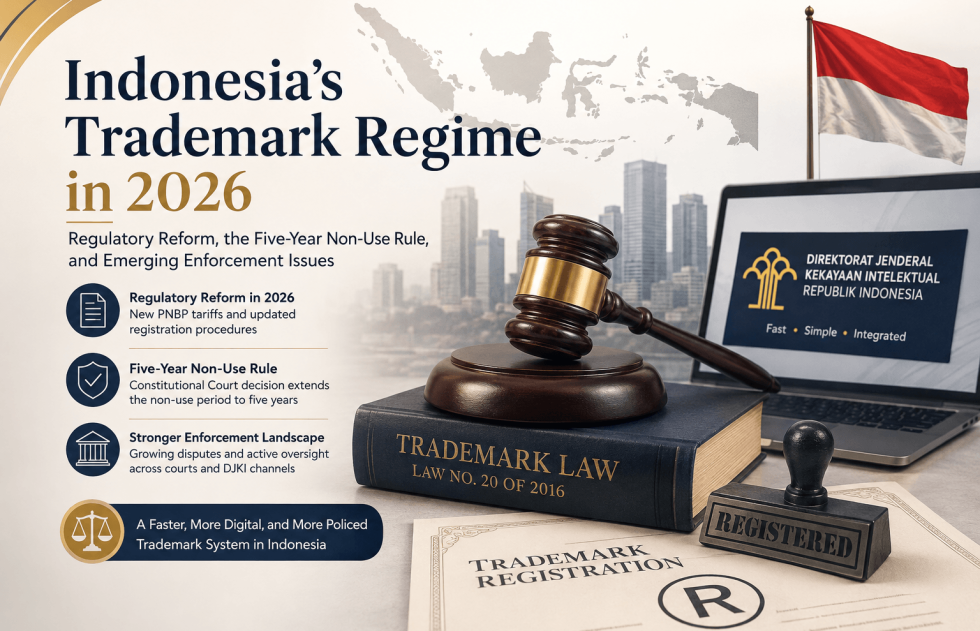
Indonesia's Trademark Regime in 2026: Regulatory Reform, the Five-Year Non-Use Rule, and Emerging Enforcement Issues
I. Introduction
Indonesia's trademark system has undergone its most consequential adjustment in nearly a decade across three interlocking tracks in 2026: a revised schedule of non-tax state revenue (Penerimaan Negara Bukan Pajak, “PNBP”) tariffs for trademark services, a judicial recalibration of the non-use cancellation doctrine that was decided in 2024 but continues to define 2026 filing and enforcement strategy, and a rewritten set of registration procedures issued by the Minister of Law. Read together with several disputes now moving through the Commercial Court, the Supreme Court, and the Directorate General of Intellectual Property’s (“DJKI”) internal opposition and mediation channels, these developments point toward a trademark system that is faster and more heavily digitalized, but also more closely policed. This article surveys the principal legal instruments, situates them against the governing statutory framework — primarily Law No. 20 of 2016 on Marks and Geographical Indications (the “Trademark Law”) — and examines several disputes that illustrate how the new rules are being tested in practice.
II. Regulatory Developments
A. Government Regulation No. 30 of 2026 on PNBP Tariffs (Effective 1 August 2026)
1. Facts
Government Regulation (Peraturan Pemerintah, “PP”) No. 30 of 2026 on Types and Tariffs of Non-Tax State Revenue Applicable at the Ministry of Law was signed by President Prabowo Subianto and supersedes PP No. 45 of 2024. It took effect on 1 August 2026 [1][2], and resets substantially all fee categories for trademark prosecution and post-registration recordal.
2. Key Changes
The standard per-class application fee for general (non-UMK) applicants rises from Rp1,800,000 to Rp2,800,000 per class of goods or services — an increase of approximately 55.6%. The fee for micro and small enterprises (Usaha Mikro dan Kecil, “UMK”) is held at Rp500,000 per class, unchanged from the prior tariff.
Post-registration and other recordal fees for general applicants have also increased materially: pre-expiry renewal from Rp2,250,000 to Rp3,500,000 (+55.6%); late renewal (within six months of expiry) from Rp4,500,000 to Rp7,000,000 (+55.6%); appeal to the Trademark Appeal Commission from Rp3,000,000 to Rp4,500,000 (+50%); recordal of a name or address change from Rp300,000 to Rp450,000 (+50%); recordal of an assignment of trademark rights from Rp700,000 to Rp1,100,000 (+57.1%); and recordal of a licence agreement from Rp1,000,000 to Rp1,400,000 (+40%). For each of these categories, the corresponding UMK tariff is maintained at its prior level.
3. Analysis
DJKI has publicly defended the increase as proportionate to the cost of a substantially faster, fully digitalized examination and certification service (discussed at Section II.C below), and has emphasised that the commercial risk of delaying registration — exposure to third-party filing under Indonesia’s first-to-file system — exceeds the cost of the higher tariff [3]. For general applicants, particularly foreign entities filing multi-class portfolios, the increase materially raises the cost of both new filings and portfolio maintenance, and warrants a review of filing strategy — for example, consolidating classes, prioritising commercially significant marks, and completing pending renewals or assignments promptly. The preservation of the Rp500,000 UMK tariff continues the government’s differentiated treatment of micro and small enterprises, a rationale that also features in Permenkum No. 5/2026 (Section II.C) and in the Constitutional Court’s reasoning in Decision No. 144/PUU-XXI/2023 (Section II.B).
B. Constitutional Court Decision No. 144/PUU-XXI/2023: The Non-Use Period Is Now Five Years
1. Facts
On 30 July 2024, the Constitutional Court (Mahkamah Konstitusi, “MK”) rendered Decision No. 144/PUU-XXI/2023, reviewing Articles 74(1) and 74(2)(c) of the Trademark Law [4]. Article 74(1) permits an interested third party to apply to the Commercial Court for cancellation of a registered mark that has not been used in trade for three consecutive years, subject to the statutory exceptions in Article 74(2). Article 74(2)(c), as originally worded, exempted from cancellation a non-use caused by a “prohibition of a similar nature” (larangan yang sejenis) to an import restriction or other government prohibition, without further defining that phrase.
2. Applicable Law and Holding
The Court declared both provisions conditionally unconstitutional. It reinterpreted Article 74(1) so that the non-use threshold triggering a cancellation action is five consecutive years, not three, and clarified that the Article 74(2)(c) exception encompasses force majeure conditions established by government regulation, including economic crises, natural disasters, and pandemics.
3. Interpretation and Analysis
The Court’s reasoning centred on the structural composition of the Indonesian economy, in which micro, small, and medium enterprises constitute the overwhelming majority of registered trademark holders and are disproportionately exposed to disruption from macroeconomic shocks, natural disasters, and public health emergencies of the kind Indonesia experienced during 2020–2022. A three-year non-use window, the Court found, does not give such enterprises adequate time to resume commercial use following that class of disruption, and the undefined “similar prohibition” exception in Article 74(2)(c) left excessive interpretive uncertainty for a proprietor invoking it as a defence.
The five-year threshold and the express recognition of force-majeure-based defences apply to all registered proprietors, not solely UMK, which has practical significance beyond the decision’s stated rationale: brand owners across all size categories now benefit from a materially longer grace period, while parties seeking to clear the register of dormant marks — a routine strategy before 2024 for challengers seeking freedom to register a confusingly similar sign — face a correspondingly longer evidentiary and time burden. Because the Court’s decision operates as a binding constitutional reinterpretation of Article 74 rather than a legislative amendment, it applies with immediate effect to any non-use cancellation action; consistent with the principle that a constitutional interpretation prevails over an unamended statutory text (lex superior derogat legi inferiori), practitioners should treat the five-year threshold as the current governing standard notwithstanding that the text of Law No. 20/2016 itself has not yet been formally revised to reflect it.
C. Minister of Law Regulation No. 5 of 2026 on Trademark Registration
1. Facts and Legal Basis
Peraturan Menteri Hukum No. 5 Tahun 2026 tentang Pendaftaran Merek (“Permenkum 5/2026”), issued as implementing regulation under the Trademark Law, was enacted on 13 January 2026 and took effect on 23 February 2026, superseding the registration-procedure framework previously set out in Permenkumham No. 67 of 2016 (as amended, including by Permenkumham No. 12 of 2021) [5][6].
2. Key Provisions
Faster substantive examination. DJKI’s target time for substantive examination is now 30 calendar days, extendable to a maximum of 90 calendar days where an application draws a provisional refusal to which the applicant responds — a marked reduction from the roughly 150-day period previously allowed. Combined with a 15-working-day formality check and the statutory two-month public opposition period, total processing now runs to roughly three-and-a-half to five months in the ordinary case [5], a substantial compression from the multi-year timelines DJKI applicants faced through the early 2020s.
Instant certificate issuance. Once a mark is approved for registration, the Minister must issue the official certificate excerpt (petikan resmi sertifikat) within one working day, replacing a process that previously took several working days [5][7].
Full digitalization. All applications must now be filed electronically through DJKI’s official portal; non-electronic channels are limited to data-entry assistance rather than substantive filing [7].
Force majeure extension mechanism. For the first time, the regulation gives applicants affected by war, natural disaster, or civil unrest a formal mechanism to request an extension of administrative deadlines, subject to Ministerial approval on the basis of supporting evidence [7]. This is a distinct, procedural accommodation from the substantive force majeure defence to non-use cancellation recognised by the Constitutional Court in Decision No. 144/PUU-XXI/2023 discussed above; the two operate at different stages of a mark’s life — prosecution deadlines, as against a post-registration non-use defence — and should not be conflated.
Simplified UMK documentation. DJKI has stated that formality requirements for micro and small enterprise applicants — principally identity documentation (KTP/e-KTP, or KIA for an applicant represented through statutory guardianship) — have been simplified [9], continuing the UMK-favourable posture reflected in the unchanged UMK PNBP tariff under PP 30/2026.
Tightened assignment and transfer requirements. Recordal of an assignment of trademark rights now requires supporting legalisation documentation confirming the transferring party’s authority to transfer (pengesahan badan hukum), and triggers a fresh public announcement of the assignment, giving third parties — including, notably, an original proprietor whose mark may have been assigned without their knowledge or consent — a further opportunity to object before the transfer is recorded. The Minister of Law, Supratman Andi Agtas, has publicly characterised this change as strengthening protection for rightful titleholders, including heirs in succession-related transfers, rather than adding bureaucratic burden, in response to concerns raised by intellectual property consultants that the additional verification step could slow legitimate portfolio transactions, particularly cross-border assignments involving foreign corporate documentation [8]. Some practitioners have also raised, in professional commentary, a related concern that certified or sworn translation of foreign corporate documents could become a de facto requirement for foreign applicants. So far as this office has been able to confirm from published sources, such translation and legalisation requirements attach to the assignment and recordal stage rather than to the initial trademark application itself; readers should nonetheless confirm the current documentary checklist against DJKI’s published requirements immediately before any specific filing, given the pace at which implementing guidance has been issued through 2026.
Administrative service target beyond the regulation itself. Separately from Permenkum 5/2026’s own provisions, the Minister of Law announced, in connection with the Ministry’s 81st Law and Human Rights Day commemoration on 19 August 2026, a further administrative target of reducing total trademark registration processing to five months (from a prior six-month benchmark) effective 1 September 2026, alongside a parallel target for industrial design registration, and has stated an ambition for Indonesia to operate the world’s fastest trademark registration service by 2027 [10]. These are service-level targets announced by the Ministry rather than a new regulation superseding Permenkum 5/2026, and should be understood as an implementation commitment layered on top of the procedural changes summarised above.
III. Emerging Issues in Practice
1. First-to-File Risk Under a Compressed Examination Timeline
The Trademark Law adopts a strict first-to-file system rather than first-to-use: priority is generally determined by application date rather than by evidence of prior commercial use, subject to the well-known-mark and bad-faith exceptions in Article 21. A faster examination cycle sharpens, rather than relieves, the practical consequence of that rule: brand owners who delay filing — including foreign entities entering the Indonesian market gradually — now have a narrower window in which an intervening applicant can register a conflicting mark and move it through to grant before the rightful commercial user files a challenge.
The ongoing Denza dispute illustrates the range of complications that can follow. BYD Company Limited, the Chinese electric-vehicle manufacturer, challenged a locally registered “Denza El” mark (Classes 12 and 37) on grounds of bad-faith registration; the mark had, however, already been assigned by the original local registrant to PT Raden Reza Adi under a notarised deed recorded with the Ministry of Law on 11 September 2024. The Supreme Court, in Decision No. 1338 K/Pdt.Sus-HKI/2025, rejected BYD’s cassation petition on the procedural ground that its claim was not receivable (niet ontvankelijk verklaard) because it had been filed against a party that no longer held title to the mark — an error in persona [11]. The case is instructive less for its substantive trademark analysis than for what it shows about the interaction between the assignment/recordal system and litigation strategy: a party contesting a locally registered mark must verify current ownership through DJKI’s register immediately before filing suit, since ownership can shift during a dispute and a claim framed against the wrong titleholder can fail on procedural grounds regardless of its merits. BYD has publicly indicated it intends to continue pursuing protection for the Denza name in Indonesia, including consideration of an alternative brand name for the local market.
2. Registration of Customary and Dynastic Titles as Trademarks
A doctrinally distinct issue has surfaced around the registration of names and titles carrying cultural or dynastic significance. In mid-2026, an application for the mark “SISKS Paku Buwono XIV” — filed for cultural and educational services, including exhibitions and conferences — drew a formal objection from within the Surakarta Sunanate (Keraton Surakarta) itself: the application had been filed at the direction of one faction connected to an ongoing succession dispute within the Sunanate, while a spokesperson for a rival faction objected on the ground that a name of this kind is not a proper object of trademark or copyright protection, and that matters touching the Keraton’s internal principles require consultation within the institution before any external filing [12]. As of this writing, the application remains at the public announcement stage and has not proceeded to registration; the objecting faction has indicated it will lodge a formal opposition with DJKI.
The underlying legal question — whether a customary, dynastic, or religious title can properly serve as a trademark, and where the absolute refusal grounds in Article 20 of the Trademark Law (covering marks contrary to state ideology, statutory provisions, morality, religion, decency, or public order) draw the line against the desacralisation of cultural symbols — remains unsettled in Indonesian jurisprudence and is likely to recur as DJKI examiners and the Commercial Court are asked to apply Article 20 to marks invoking traditional or religious authority. Because this particular dispute is also entangled with an internal succession controversy that is not itself an intellectual property question, its ultimate disposition may turn as much on standing and evidentiary issues specific to the Keraton’s internal governance as on the trademark merits, and it should be read as illustrative of the broader Article 20 question rather than as a precedent on the succession dispute itself.
3. Non-Litigation Resolution Through DJKI Mediation
Alongside these contested matters, DJKI has continued to expand non-litigation dispute resolution as a matter of policy. Between January 2022 and 20 May 2026, DJKI’s mediation service concluded 104 intellectual property mediation requests, the majority involving copyright and trademark disputes, with a target processing time of nine business days per mediation [13]. Director General Hermansyah Siregar has framed mediation as offering a more effective and efficient forum for dialogue between disputing parties than litigation, and the Directorate has moved case intake onto an electronic complaint system to support more systematic handling. For trademark proprietors facing a straightforward opposition or infringement dispute with a commercially cooperative counterparty, mediation offers a materially faster and lower-cost alternative to Commercial Court litigation — though it necessarily depends on both parties’ willingness to negotiate, and will not substitute for adjudication in disputes, such as the bad-faith and ownership questions raised by Denza, that turn on contested findings of fact or law.
IV. Conclusion and Practical Implications
Taken together, PP No. 30/2026, Constitutional Court Decision No. 144/PUU-XXI/2023, and Permenkum No. 5/2026 point toward an Indonesian trademark system that is faster and more heavily digitalised, but also — through tightened assignment verification, a longer non-use grace period, and continued reliance on a strict first-to-file rule — more demanding of proactive portfolio management. For rights holders, the practical consequences can be stated plainly even where individual disputes remain unsettled: file early and comprehensively, given the combination of first-to-file priority and a shorter examination timeline; budget for the higher general PNBP tariff while confirming eligibility for the preserved UMK rate where applicable; treat the five-year non-use threshold as the current governing standard, both offensively (in challenging a dormant competing mark) and defensively (in maintaining an underused registration); verify current ownership on the DJKI register before initiating any assignment-related or infringement litigation; and monitor DJKI’s evolving documentary requirements for assignments, particularly for foreign-originated corporate documentation, given that implementing guidance in this area continues to be clarified through 2026.
Given the pace of regulatory change evident across all three developments discussed above, rights holders and counsel should treat DJKI’s own published regulations and official announcements — rather than secondary commentary, including this article — as the authoritative reference point for any filing decision, and should confirm current requirements immediately before each filing rather than relying on a static understanding of the rules.
V. References
[1] Direktorat Jenderal Kekayaan Intelektual (DJKI), “Peraturan Pemerintah Nomor 30 Tahun 2026 tentang Jenis dan Tarif atas Jenis PNBP yang Berlaku pada Kementerian Hukum”, dgip.go.id
[2] CNBC Indonesia, “Pendaftaran Merek Naik 55%, Ini Daftar Lengkap Tarif PNBP Terbarunya” (16 July 2026), cnbcindonesia.com
[3] DJKI, “DJKI Sesuaikan Tarif Merek, UMK Tetap Dapat Keringanan”, dgip.go.id
[4] Mahkamah Konstitusi Republik Indonesia, Putusan Nomor 144/PUU-XXI/2023 (30 July 2024); summarised in Leks&Co, “Ketentuan Merek Terdaftar yang Tidak Digunakan (Non-Use) Pasca Putusan Mahkamah Konstitusi Nomor 144/PUU-XXI/2023”, blog.lekslawyer.com
[5] ANTARA News, “Permenkum baru percepat durasi pemeriksaan substansif merek”, antaranews.com
[6] JDIH DGIP, “Peraturan Menteri Hukum RI Nomor 5 Tahun 2026 tentang Pendaftaran Merek”, jdih.dgip.go.id
[7] Veritask, “Permenkum Nomor 5 Tahun 2026 Percepat Digitalisasi Pendaftaran Merek dan Atur Mekanisme Force Majeure”, veritask.ai
[8] Hukumonline, “Pemerintah Klaim Permenkum 5/2026 Bukan Tambah Birokrasi, Tapi Perkuat Proteksi Merek”, hukumonline.com
[9] DJKI, “DJKI Permudah Syarat Merek UMK Melalui Permenkum Nomor 5 Tahun 2026”, dgip.go.id
[10] Sindonews, “Menkum: Pendaftaran Merek Dipangkas Jadi 5 Bulan, Mulai Berlaku 1 September 2026”, nasional.sindonews.com
[11] Hukumonline, “MA Tolak Kasasi BYD dalam Sengketa Merek Denza”, hukumonline.com
[12] Detik Jateng, “Polemik Gelar Raja Keraton Solo Didaftarkan Jadi Merek”, detik.com
[13] Tribun Jabar, “DJKI Selesaikan 104 Sengketa Kekayaan Intelektual Melalui Mediasi”, jabar.tribunnews.com
[14] Law of the Republic of Indonesia No. 20 of 2016 on Marks and Geographical Indications, Arts. 20, 21, 74.
This article is provided for general information purposes only, reflects publicly available sources as of the date above, and does not constitute legal advice. Given the pace of regulatory change through 2026, readers should confirm current requirements with DJKI or qualified counsel before relying on this article for a specific filing or dispute.