MANDATORY HALAL CERTIFICATION
18 OCTOBER 2026
A Guide for SMEs and Foreign Businesses in Indonesia
BEYOND LEGAL PARTNERSHIP
Jakarta, Indonesia
18 October 2026 is coming, whether your business is ready or not. After that date, almost everything sold in Indonesia, from fried snacks at a roadside stall to imported skincare sold through a marketplace, has to carry clear halal status. Either a formal certificate, or, where that is not possible, a clear non-halal declaration that follows the standard format.
The rule itself is not new. Indonesia's Halal Product Assurance Law has been in force since 2014, and larger businesses were already required to comply back in 2024. What makes October 2026 different is that two groups who had extra time are now joining the mandatory wave: micro and small enterprises, and imported products.
This is where a lot of confusion sets in. Local SME owners often put it off until the last minute, assuming the process is complicated and expensive, when most of them actually qualify for the fastest and free track. Meanwhile, quite a few foreign business owners in Indonesia, especially those running cafes, restaurants, or cosmetics brands through a PT PMA, have no idea the rule applies to them too, including how a menu item containing pork or alcohol needs to be labelled to stay on the right side of the law.
What is actually required, and since when
The legal basis sits in Law No. 33 of 2014 on Halal Product Assurance, with the technical detail spelled out in Government Regulation No. 42 of 2024. Together they require halal certification for goods and services connected to food, beverages, slaughter results and slaughtering services, traditional medicine, cosmetics, chemical products, biological and genetically engineered products, and certain worn goods such as leather items that touch the body.
Enforcement has come in stages. Medium and large businesses were already required to comply from October 2024. The deadline for SMEs was pushed back from 2024 to October 2026 because the government recognised many small businesses weren't ready. That grace period is now closing. The phase-in for micro and small enterprises ends on 17 October 2026, and the day after, the full obligation takes effect, imported products included.
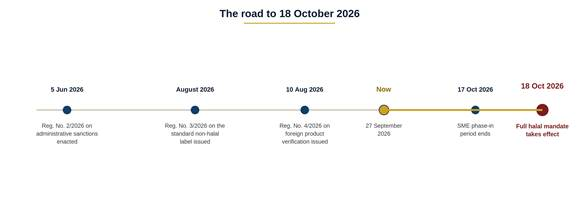
The regulatory build-up to the 18 October 2026 deadline
One thing worth underlining: this requirement doesn't mean every product has to carry a halal label. What's required is certainty of status, and that status can either be a halal certificate, or, for products that could never be halal to begin with, a clear non-halal declaration. Both are legally valid. What isn't allowed is having neither.
Two certification tracks, and which one fits your business
For businesses that do need a halal certificate, there are two tracks, and picking the wrong one can drag the process out far longer than it needs to be.
Self-declaration is built for micro and small businesses with simple production processes. The main requirements: a business registration number (NIB) at micro or small scale, ingredients with clear halal status, a production process with no real risk of contamination from non-halal materials, and generally just one production site and one outlet. The annual turnover ceiling BPJPH uses for this track is around Rp15 billion. Because there's no on-site audit, this track moves much faster, needing only verification from a Halal Process Assistant (Pendamping PPH) before going to the MUI fatwa session.
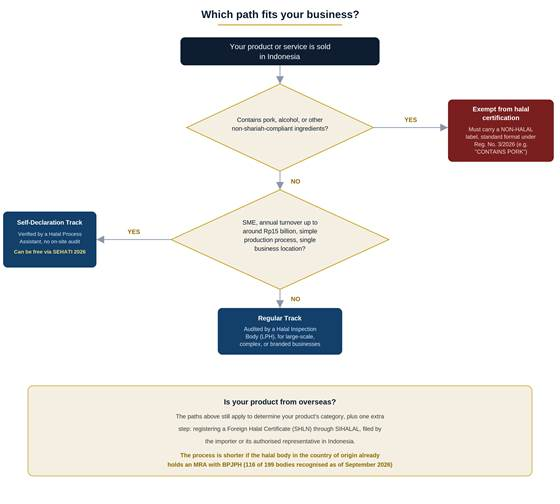
A simple way to work out which compliance category your business falls into
1.35 million free halal certificates available through the 2026 SEHATI program for eligible SMEs |
There's one detail that often gets missed, particularly by foreign business owners: every business is required to have a Halal Supervisor (Penyelia Halal), and that person must be Muslim. If you own a PT PMA and you're not Muslim, you can still go through certification, you just need to appoint a Muslim staff member for this role.
The regular track applies to businesses that don't meet the criteria above: medium or large scale, multiple branches, a central kitchen, ingredients sourced from overseas suppliers, or branded products made under contract manufacturing. This track involves a direct audit by a Halal Inspection Body (LPH) before moving to the fatwa session, which makes it slower and not free.
| Criteria | Self-Declaration | Regular |
| Business scale | Micro and small | Medium and large |
| Cost | Can be free via SEHATI 2026 | Paid, per LPH rates |
| Verification | Halal Process Assistant, no on-site audit | Direct audit by a Halal Inspection Body |
| Best suited for | Simple ingredients, single location, already-halal materials | Multiple branches, central kitchen, imported ingredients, contract-manufactured products |
| Estimated timeline | Relatively faster | Longer, depends on audit queue |
If your product comes from overseas
This is the part foreign business owners and importers most often overlook. BPJPH issued Regulation No. 4 of 2026 on Verifying the Conformity of Foreign Halal Products, which makes one thing clear: holding a halal certificate from the country of origin isn't enough on its own. The product still has to be registered through the SIHALAL system to get a Foreign Halal Certificate (SHLN) registration number before it can be sold in Indonesia, and it's the importer or its authorised representative who files that registration, not the overseas manufacturer.
116 of 199 foreign halal bodies now hold a mutual recognition agreement (MRA) with BPJPH, as of September 2026 |
The good news is the process doesn't start from zero for every country. If your product is certified by one of the bodies already recognised through an MRA, registration is considerably more straightforward than going through full verification.
The Ministry of Trade has confirmed this isn't an import ban. Foreign products can still enter as long as the requirements are met. But for PT PMA owners importing raw materials or finished products, particularly in cosmetics and food and beverage, this means checking two things before 18 October: which body issued your product's halal certificate, and whether that body is on BPJPH's MRA list.
If your business sells pork or alcohol
This is the part most relevant to the many expat-owned restaurants, bars, and specialty grocers in Bali and other cities, and unfortunately the part most often misunderstood. There are two equally wrong assumptions: that products containing pork or alcohol are automatically banned, or the opposite, that because they can never be halal-certified, they're free of any obligation at all.
The reality sits in between. Products containing pork, alcohol from khamar processing, or other prohibited ingredients are actually exempt from the halal certification requirement. But in exchange, they're required to carry a clear non-halal declaration, under Articles 92 and 93 of the Halal Product Assurance Law and Article 2 of Government Regulation No. 42 of 2024.
Since BPJPH Regulation No. 3 of 2026, the format for this declaration has been standardised, not just any wording will do. Products containing pork must display the words "MENGANDUNG BABI" ("contains pork") in red, alongside a pig illustration, inside a red rectangular box on a white background. Products with other non-halal ingredients, alcohol included, must display "NON HALAL" in a specified shade of red. There's one practical exception: if a product's trade name already explicitly includes the word "babi" (pork), that's considered sufficient on its own, no additional label needed.
ILLUSTRATIVE SCENARIO, NOT AN ACTUAL CASE A foreign national opens a beach club in Canggu with a menu built around grilled pork burgers and a long cocktail list. He doesn't need to chase a halal certificate for any of it, and he doesn't need to shut anything down. The one thing he has to do is display "MENGANDUNG BABI" and "NON HALAL" in BPJPH's standard format on the relevant menus and signage. Skip that, and he can still face an administrative penalty, even though everything he's selling is entirely legal. |
For restaurant and bar owners, this isn't about closing up shop or chasing a certificate you were never going to get for certain menu items anyway. It's about making sure the menu and packaging for anything containing those ingredients carries the correct declaration, somewhere a customer can easily see it. Skipping it can still result in an administrative penalty, even though the product itself is perfectly legal to sell.
If you're late, penalties escalate in stages
BPJPH has the authority to impose sanctions under Regulation No. 2 of 2026, and that authority isn't limited to business operators, it also covers Halal Inspection Bodies, halal auditors, and Halal Process Assistance providers if they fail to do their job properly.
The sequence is staged: a written warning comes first, and if ignored, it escalates to an administrative fine, product withdrawal from circulation, revocation of the halal certificate, suspension of operations, and, for more serious or repeated violations, cancellation of the registration number. In some regions, enforcement has already gotten concrete. BPJPH's Lampung regional office, for instance, set a warning cadence of one month, one month, then three months before harsher sanctions such as a sales freeze are imposed, though the exact timing can vary by region and type of violation.
If your business ends up sanctioned and you believe the decision was wrong, there's a formal objection route to the Head of BPJPH. It's not a process that automatically works in your favour, but it does give you a chance to be heard before a serious sanction like certificate revocation is actually carried out.
The most common mistakes
|
Practical steps before the deadline
Before 18 October 2026
|
The mandatory halal rule isn't really a one-size-fits-all policy. How you comply depends on who you are: a home-based culinary SME, a foreign restaurant owner serving a mixed menu, or a cosmetics importer, each faces a different track and a different set of obligations. The most important first step isn't rushing to register, it's working out which category you actually fall into. Getting that wrong at the start is usually what drags the process past the deadline.
If you're not sure which category your business falls into, or need help preparing documentation for import registration or a compliant non-halal label, our team at Beyond Legal Partnership can help you map it out before 18 October.
Frequently asked questions
My restaurant is foreign-owned in Bali and only serves standard western food, do I still need halal certification?
It depends on the ingredients. If everything is confirmed halal, you're still required to certify, through self-declaration or the regular track depending on your business scale. If any menu item contains pork or alcohol, that item is exempt from certification but must carry a non-halal declaration.
I own a PT PMA and I'm not Muslim, can I still handle certification myself?
Yes, but you're required to appoint a Muslim Halal Supervisor to oversee the process, since that requirement attaches to the role itself, not to nationality or business ownership.
My product already has a halal certificate from a body in its home country, does that automatically apply in Indonesia?
Not automatically. It still needs to be registered through SIHALAL to receive a Foreign Halal Certificate (SHLN) number. The process is shorter if the issuing body already holds a mutual recognition agreement with BPJPH.
How long does certification take to come through?
The self-declaration track is generally faster since it skips the on-site audit. The regular track takes longer because it involves an LPH audit and an MUI fatwa session. BPJPH has previously aimed to speed up service, but actual turnaround still depends on how complete the submitted documents are.
This article is prepared for general informational purposes and does not substitute for legal advice. For guidance specific to your business, contact Beyond Legal Partnership.