

RECOVERING CROSS-BORDER DEBT
The Legal Pathways That Actually Work in Indonesia
BEYOND LEGAL PARTNERSHIP
Jakarta, A Practical Guide to Cross-Border Business Law
Many creditors who have already won a lawsuit in a foreign court are startled to learn that the judgment cannot simply be used to seize a debtor's assets in Indonesia. The judgment itself is not the problem. Indonesian law simply does not recognize automatic enforcement of foreign court judgments.
This is not some obscure loophole. It is the basic rule that applies to nearly every cross-border debt dispute, whether an Indonesian creditor is chasing a debtor abroad or the other way around. The good news is that there are legal pathways that genuinely work, provided you know which one fits your situation and when to start preparing, ideally before the contract is even signed.
This article walks through the three pathways that matter most in practice: filing a fresh lawsuit in an Indonesian court, enforcing an international arbitral award, and using PKPU, Indonesia's debt moratorium proceeding, as leverage. Each comes with its own requirements, speed, and risks.
Foreign Court Judgments Are Not Automatically Enforceable in Indonesia
The rule traces back to Article 436 of the Reglement op de Rechtsvordering (Rv), a piece of colonial-era civil procedure law still applied on this point today. The principle is straightforward: a court judgment is an expression of the sovereignty of the state that issued it, so it cannot simply be forced to apply in another country. Indonesia also has not ratified any international convention on recognizing foreign court judgments, unlike its position on arbitral awards.
The consequence is concrete. A creditor who wins a judgment in, say, a Singapore court cannot hand that judgment to a bailiff at an Indonesian District Court and ask for assets to be seized. What has to happen instead is filing a fresh lawsuit at the Indonesian District Court with jurisdiction, usually where the debtor is domiciled, and having the case heard from scratch as if it had never been decided anywhere else.
Article 436 Rv The legal basis that keeps foreign court judgments from being automatically enforceable in Indonesia |
The foreign judgment is not wasted, though. It can be submitted as documentary evidence in that new lawsuit, and in practice it carries real weight in proving the existence and amount of the debt. But its status remains evidentiary, not a basis for enforcement. The Indonesian judge hearing the case retains full authority to reassess the merits.
Some practitioners point to the principle of reciprocity, the idea that a foreign judgment might be recognized if the country where it was issued also recognizes Indonesian court judgments. In theory this sounds like a shortcut. In practice its application has been inconsistent and it has not become a pathway creditors can rely on. For strategic purposes, it is safer to treat a fresh lawsuit as the only certain route when there is no arbitration clause, and reciprocity as a supporting argument rather than a primary strategy.
International Arbitration: A Far More Reliable Pathway, With One Weak Point
Indonesia's posture toward foreign arbitral awards is entirely different from its posture toward foreign court judgments. Indonesia ratified the 1958 New York Convention through Presidential Decree No. 34 of 1981, and the mechanism is set out in detail in Law No. 30 of 1999 on Arbitration and Alternative Dispute Resolution, specifically Articles 65 through 69.
An application to recognize and enforce an international arbitral award is filed with the Clerk of the Central Jakarta District Court. This is the only court in the country authorized to handle such applications, so the debtor's location elsewhere in Indonesia does not change where the application must be filed at this stage.
1 Court Only the Central Jakarta District Court is authorized to handle exequatur applications for all of Indonesia |
Article 66 of the Arbitration Law sets four conditions before an international arbitral award can be recognized and enforced in Indonesia:
| FOUR REQUIREMENTS UNDER ARTICLE 66 | |
| 1 | Reciprocity The award was issued in a country bound to Indonesia by treaty, which in practice means a New York Convention member state |
| 2 | Commercial Scope The dispute falls within the scope of commercial law under Indonesian law |
| 3 | Public Order The award does not conflict with public order |
| 4 | Exequatur It has obtained an exequatur from the Chief Judge of the Central Jakarta District Court |
The third condition is where things most often go wrong. Public order is not defined in detail in the statute, and some Indonesian court decisions have interpreted it broadly, reaching into the merits of a case that an arbitrator had already finally decided. The Pertamina v. Karaha Bodas Company dispute and the Astro Group v. PT Direct Vision case are frequently cited as examples of how a public order argument can be used to resist enforcement. This does not mean an exequatur is hard to obtain. It means the quality of the arbitration process and the clarity of the arbitration clause both matter to how much this risk actually materializes.
There is one advantage creditors rarely appreciate. Once the Chief Judge of the Central Jakarta District Court grants an exequatur, the decision is final and binding, with no right of appeal or cassation. If the application is refused, on the other hand, the applicant can still pursue cassation. So once an exequatur is secured, the process wraps up far faster than a lawsuit that can drag on through to a review request.
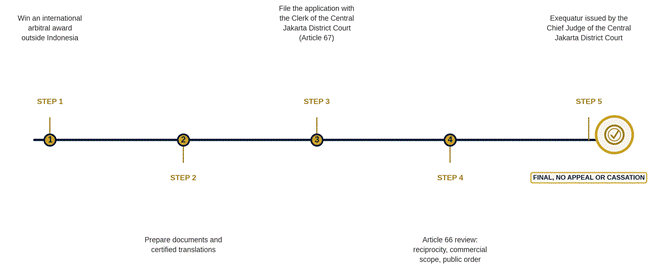
The pathway to recognizing and enforcing an international arbitral award in Indonesia
Because this pathway is so much more dependable than litigation, the single most consequential decision happens before any dispute arises, when the dispute resolution clause is drafted. An arbitration clause that clearly names a seat in a New York Convention member state, specifies the institution (BANI, SIAC, or ICC, for instance), the language of proceedings, and the governing law often turns out to be the one factor that determines whether assets in Indonesia can actually be reached later.
PKPU: The Pressure Tool Cross-Border Creditors Often Overlook
Beyond the two pathways above, there is one instrument foreign creditors frequently ignore despite how effective it can be: PKPU (Penundaan Kewajiban Pembayaran Utang, Indonesia's suspension-of-debt-payment proceeding), governed by Law No. 37 of 2004 on Bankruptcy and PKPU, and heard at the Commercial Court, a specialized division within the District Court system.
Indonesian bankruptcy law does not distinguish creditors by nationality. A foreign creditor has the same standing as a domestic one to file for PKPU or bankruptcy against a debtor in Indonesia, provided the requirements are met: the debtor has at least two creditors, at least one debt is due and payable, and this can be proven through summary evidence. That lighter evidentiary standard is what makes PKPU so much faster than an ordinary civil lawsuit.
270 Days The maximum length of the full PKPU process from the moment a temporary PKPU is granted, far faster than an ordinary lawsuit |
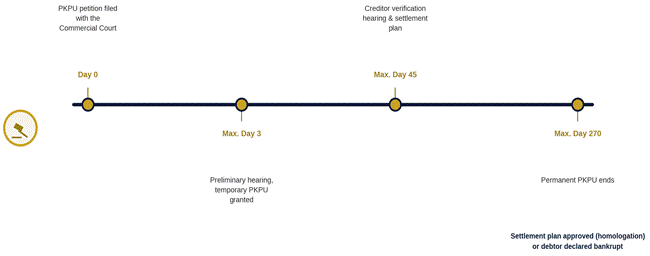
Illustration of the PKPU timeline under Law No. 37 of 2004
This speed is exactly what makes PKPU an effective pressure tool. Once a petition is filed, the Commercial Court can grant a temporary PKPU within days, and the full PKPU process is capped at a maximum of 270 days from the date the temporary PKPU is pronounced. For a corporate debtor, the threat of losing control over its assets to a court-appointed administrator, plus the reputational damage that comes with it, is often enough to push it toward serious negotiation, sometimes far faster than a formal demand letter or waiting out an ordinary lawsuit would achieve.
One thing foreign creditors must keep in mind: they cannot file this petition on their own from abroad. The application has to be signed jointly with an Indonesian-licensed advocate, backed by a power of attorney. This is not a mere formality. Even a small procedural error can get an application rejected.
There is also something that needs to be understood from the outset: the international reach of Indonesian bankruptcy law is very limited. If a debtor has already been declared bankrupt in another country, that ruling does not automatically extend to reach the debtor's assets in Indonesia, and the reverse is also true. So if the assets being pursued are located in Indonesia, a separate PKPU or bankruptcy petition has to be filed here regardless of whether a similar process is already underway elsewhere.
Comparing the Three Pathways
None of these three pathways replace the others. Each fits a different situation, and in some cases they can be used together.
| Aspect | Fresh Lawsuit at the District Court | International Arbitration | PKPU |
| Legal basis | Article 436 Rv, general civil procedure law | Law No. 30/1999 + New York Convention (Presidential Decree No. 34/1981) | Law No. 37/2004 on Bankruptcy and PKPU |
| Competent authority | District Court where the debtor is domiciled | Central Jakarta District Court (exequatur) | Commercial Court |
| Main requirement | Case is reheard from scratch | Valid arbitration clause, seated in a New York Convention member state | At least 2 creditors, a debt that is due, proven by summary evidence |
| Estimated time | 1 to 3 years if appeal and cassation are involved | Varies, depending on the arbitration process, plus the exequatur process | Maximum 270 days from the temporary PKPU |
| Main risk | Doubled time and cost, uncertain outcome | Application can be refused on public order grounds | Does not reach assets outside Indonesia |
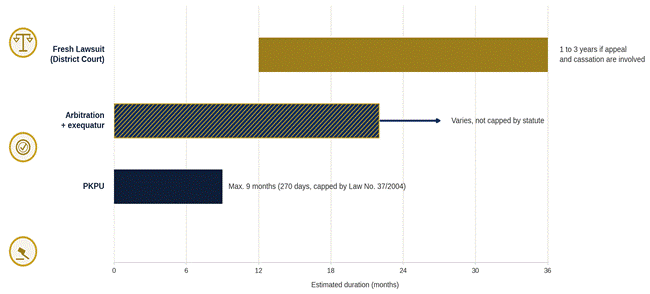
Estimated duration of each pathway. The arbitration bar is drawn open-ended because the law sets no fixed time limit for it.
Choosing the Right Pathway for Your Situation
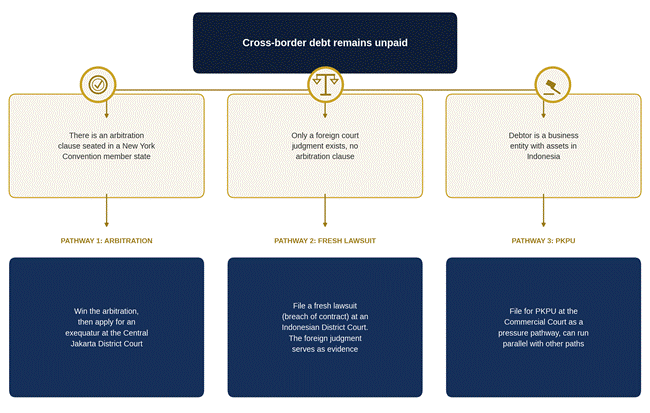
- If your contract contains a valid arbitration clause with a seat in a New York Convention member state, arbitration is the most realistic option, and preparation should focus on the quality of the arbitration process itself, not just the exequatur at the end.
- If all you have is a foreign court judgment and no arbitration clause, the only available route is a fresh lawsuit in Indonesia, with the foreign judgment serving as strong supporting evidence.
- If the debtor is a business entity with real assets in Indonesia, such as bank accounts, property, or shares, PKPU is worth considering as a pressure tool, whether on its own or running in parallel with a lawsuit or arbitration.
The three can also be combined. A fairly common approach is to file for PKPU first to push the debtor toward negotiation, while keeping a lawsuit or arbitration process ready as a fallback in case PKPU does not produce a settlement.
Preparing Your Documents, and Preventing This From Happening in Your Next Contract
Before pursuing any of these pathways, there are a few documents almost always required:
DOCUMENTS TO PREPARE ✓ Original contract and its attachments ✓ Evidence of communication regarding the debt, such as invoices, demand letters, and email correspondence ✓ Identity documents for both debtor and creditor ✓ A certified translation into Indonesian of any foreign court judgment or arbitral award, plus legalization or an apostille depending on the document's country of origin ✓ A power of attorney to an Indonesian-licensed advocate |
For contracts not yet signed, there is one preventive step that is far cheaper than chasing an unpaid debt: drafting a clear choice-of-law and dispute resolution clause from the start, ideally arbitration with a seat in a New York Convention member state and a specifically named institution. A vague clause on this point is one of the most common reasons cross-border debt recovery drags on for years.
THE MOST COMMON MISTAKES
|
The Bottom Line
What determines whether cross-border debt can actually be recovered is not the size of the claim, but which legal pathway is used from the outset, and how carefully the dispute resolution clause was drafted into the contract. If that clause already exists and is clear, the path forward is far more direct. If it doesn't, PKPU and a fresh lawsuit remain available, they just require more thorough evidence preparation from the start.
Frequently Asked Questions
Can I seize a debtor's assets in Indonesia directly using a foreign court judgment?
No. The judgment has to be re-filed as a fresh lawsuit in an Indonesian court, where it functions only as evidence, not as a basis for direct enforcement.
How long does a PKPU process usually take?
A temporary PKPU lasts a maximum of 45 days, and the entire PKPU process is capped at 270 days from the date the temporary PKPU is granted, far faster than an ordinary civil lawsuit that can run for years once appeals and cassation are involved.
Does a foreign creditor need to have an office in Indonesia to file for PKPU?
No. What's required is a power of attorney to an Indonesian-licensed advocate, since the petition must be filed and signed jointly with that advocate.
What's the difference between bankruptcy and PKPU for a creditor?
PKPU creates room to negotiate a settlement plan before a debtor is declared bankrupt, while bankruptcy immediately hands control of the debtor's assets to a court-appointed curator to be sold and distributed to creditors. Many creditors use PKPU first because the threat of bankruptcy behind it is often enough to push a debtor toward negotiation.
Got a receivable stuck across a border? Every cross-border debt case has details that determine which pathway is fastest and cheapest for the creditor. The team at Beyond Legal Partnership regularly handles cross-border matters like these and can help assess which pathway fits your contract and your position. |